On Dec. 4, as Hollywood was metabolizing the news that the studio of Citizen Kane, Casablanca and Harry Potter was about to be owned by the platform of Tiger King, Dahmer and Squid Game, I reached out to a high-ranking studio executive in town to gauge his thoughts. “Disaster,” he texted, before proceeding to explain how the swallowing of a studio by a streamer would spell bad news, whether it meant no Warner Bros. films to sustain movie theaters or a lot less Netflix outside licensing to sustain movie studios. The streamer of House of Cards could bring down the whole shaky structure.
By Monday, with Paramount’s David Ellison tilting at windmills to try to stop Ted Sarandos’ Netflixian invasion, the studio executive hummed a different tune. He didn’t feel as morose as he did a few days earlier, he said. Not that he thought disaster was any less likely — even if Ellison won, major consolidation awaited, plus Ellison’s Trump connections. No, the executive had simply resigned himself to the contracting Hollywood this all represented. To this new arena of few big, let alone original, hits; to a place where expensive, corporatized storytelling could hold no candle to the quick-turn, inexpensively made short videos young people watched or the quick-turn, inexpensively made long podcasts older people listened to.




And so rather than choose between two false saviors, he decided just to take out the popcorn and watch them duke it out.

You couldn’t avoid the irony: The drama for how traditional Hollywood will be devoured is now as entertaining as anything Hollywood could ever come up with. Movies have conflicts between gritty human characters; late-stage capitalism has the son of a tech centibillionaire and the leader of a $400 billion international giant trading insults at Wall Street-analyst conventions. (Ellison: “Netflix … offers inferior and uncertain value.” Sarandos, wearily: “Entirely expected.”)
Oh, and don’t forget Saudi money and the president’s son-in-law, both financing Ellison’s bid — or both parties cozying up to a president who fancies himself an M&A gatekeeper.
The town’s leadership gap is impossible to miss; the C-suite is fading with no big names to fill it. Comcast’s Brian Roberts (66) and Disney’s Bob Iger (74) both preside over companies whose models, of cable subscriptions and theme-park merchandising, now seem less aggressively capitalistic than quaintly from another era — and how much longer are those guys here for, anyway? (Iger’s announcement Thursday that Disney would be going all in on recycled-AI videos did not, for all its patina of the future, suggest a bold leap forward.) Many of the leaders-in-waiting lack the stature or vision, and those that appear to have it — Universal’s Donna Langley and Disney’s Dana Walden or Josh D’Amaro come to mind — have to fight boards, share prices and, most crucially, falling profits that don’t facilitate risk-taking and vision.
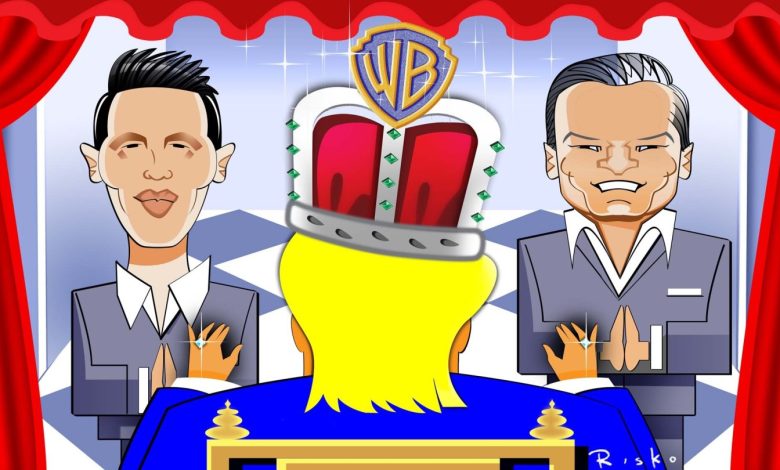
In comes Sarandos, who has defied the odds at every turn with his upstart streaming company, and Ellison, born on third base with a fierce determination to be a mogul. These are our options. These are the two men vying to be the Last King of Hollywood. Two men, separated by 20 years but united by their belief that they are the true standard-bearers of the Dream Machine that Jack Warner and Irving Thalberg and Carolyn Strauss and Bob Evans and Sheri Lansing and Barry Diller built way back in the 20th century.
Sarandos: “We want HBO to double down on the things that people have loved for 50 years.” Ellison: “We love the movie and entertainment business; we believe deeply in its future and we want to preserve and strengthen it.” Never mind that neither man before this year has ever presided over anything close to a traditional Hollywood entertainment entity. And one of them, Sarandos, has shown flashes of disdain for it.
In some ways, the purchase of one of the oldest studios by one of the newest disrupters would be a development long coming. Silicon Valley has been devouring the traditional industry for many years now — forcing companies to alter their business models, spending practices, release patterns and, soon enough in this age of AI, their production methods. And yet something feels jolting. Netflix was a disrupter, a forever-scrapper trying to gain the respect of Warner Bros. It wasn’t supposed to be owning Warner Bros. It’s hard to fathom now, but talk for years was of how a major studio might buy Netflix, not the other way around.
David Ellison seems an even less likely leader: An up-and-down movie financier with cloud-software money is not supposed to become the industry’s biggest kingpin in the space of a few years. At least Rupert Murdoch built his thing.
But the identity of this Hollywood king, for all the understandable business headlines and drama, is in a way beside the point. With the empire so bleak, you could wonder why anyone would want to rule it at all. Audiences are distracted, costs are unmanageable and automation is coming; soon, everybody who ever wrote a piece of fan fiction will be able to make a film with the push of an LLM button (as Disney just accelerated). Why own the lot when anyone can scale the gate?
Green shoots will emerge and people will fight back, of course; the nature of human striving, and dare I say the Hollywood soul, is to chafe at the hegemony. But the Hollywood that any of us have known, that of a feverish machine of human-led movie studios and television networks and cable channels and, yes, streamers, all cranking out levels of newness for people to enjoy and argue about, seems for the first time in our lives not just imperiled but doomed to degradation.
And so it makes you wonder what exactly either of these would-be emperors hopes to control. Box office is wobbly, broadcast and cable television are in the sunken place, and online platforms like TikTok and YouTube regularly wipe the floor even with Netflix, as the company’s own executives reminded at a Wall Street conference Monday in their (ironic) bid to seem like underdogs to federal regulators. It would be like Alexander the Great triumphantly riding into Persia only to realize the Royal Road was full of potholes. What exactly has been conquered?
Never mind the ways this king will be overlorded by the real emperor — less a ruler than a colonial governor. Sarandos reportedly met with Trump at the White House this month after previously meeting with him at Mar-a-Lago; Ellison sat with him in the Kennedy Center after previously sitting with him at a UFC Fight (apply your own metaphors).
The desperate wooing of Trump-world figures has been evident with both men. Sarandos reportedly brought former Trump administration official Clete Willems to the White House meeting. Ellison hired another former Trump administration official, Makan Delrahim, as Paramount’s chief legal officer. The 42-year-old even brought on Jared Kushner’s investment company to his Warners bid. At one of the meetings between Ellison’s and Trump’s emissaries, Ellison reportedly promised “sweeping changes” to CNN if somehow Trump can jury-rig Warner Bros. to him. The Hollywood throne is not Augustus but Honorius, who had to rely on a military strongman to maintain his hold on power. And in the end, Rome was sacked anyway.
Meanwhile, the bidding keeps going up — $50 billion! $60 billion! $80 billion! $110 billion! On Tuesday, former Disney executive Kevin Mayer, who helped that company buy Fox eight/a million years ago, said he expected Ellison to make a “meaningfully sweetened offer” even beyond that last figure (if it gets high enough, Netflix may walk away). When you lack confidence in what you’re buying, you derive meaning from the price tag. Certainly something that costs that much can’t be worth so little?
In a sane world, Hollywood and its impressive storehouse of wildly creative minds, of course, is worth a lot; the number of storytellers and craftspeople is dazzlingly still the highest per capita of any place on the planet. But our world has gone upside down, with tech companies that algorithmize emotion or recycle the past seen as innovators while the beacons of originality — writers and directors and actors and editors and production designers — are the ragtag back-of-the-plane survivors from the other side of the Lost island. The company that programmatically serves up true-crime dopamine hits is the pioneer; the money that flows from cloud-software platforms the protector. I don’t know that a younger Ellison family member has ever been an underdog a day in their lives. Yet somehow here we are, a whole swath of the business chanting “Save Us Davey,” without stopping to ask who would save them from him.
Meanwhile, some in Hollywood are rooting for Sarandos to save the business from the Trump-aligned Ellisons, without stopping to ask who will save the business from Sarandos.
The dilemma in all this seems impossible. Opt for the algorithm and the likelihood of theaters going away, or go for the studio of Brett Ratner and a cable-news network shadow-run by Trump and maybe lose theaters anyway. Yet between these two men, only one can rule — not because the empire is so vast but because, in the end, the spoils are so few.
HiCelebNews online magazine publishes interesting content every day in the celebrity section of the entertainment category. Follow us to read the latest news.