For Tamara Deverell, Frankenstein truly came alive on a trip to Scotland.
The production designer, whose collaboration with writer-director Guillermo del Toro dates back nearly 30 years to the sci-fi drama Mimic, was briefed on the adaptation of Mary Shelley’s classic long before del Toro’s script was written. “I know him intuitively and I’ve worked with him so long that I get what he is going to ask for,” she says. Deverell went all over the world, searching for what could best realize del Toro’s vision, and eventually came upon the country where Shelley wrote the sci-fi novel. Del Toro tagged along.



“When we scouted in Scotland and around the U.K., that was the first time I really spent time with Guillermo [while working on this project] — and I was already months into it,” Deverell says. “We were constantly drawing from things: the cobblestones, the stone textures … and Oxford University had these incredible old arch buildings.”
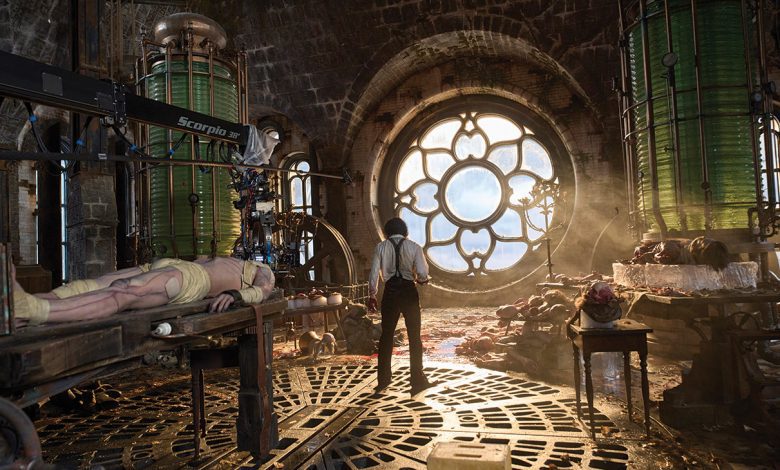
The National Wallace Monument in Stirling inspired the lab of Victor Frankenstein (Oscar Isaac), and she drew from the University of Glasgow’s vaulted ceilings for the cell of the Creature (Jacob Elordi).
“There’s nothing like standing in these places and being so inspired — with Guillermo along as a bonus,” Deverell says.
Frankenstein is nominated for nine Oscars, the bulk of which highlight its decadent design, all rooted in the kind of deep, immersive research that Deverell describes. Del Toro worked primarily with returning colleagues and emphasized coordination among departments. This was particularly true for the connection between Deverell’s massive, detailed set builds and the roving cinematography by Dan Laustsen, who was tasked with capturing the scale of the production. “Dan lights from the outside, so I have to make sure that I’m always designing with him in my mind,” Deverell says. “When you’re exhausted and giving your all, you know that it’s going to be filmed so beautifully.”
Referring to Frankenstein’s single-source lighting method, del Toro explains: “It means the majority of the lights are outside, so the set has a huge amount of light coming through a window. Basically, you are gaffing the light with the set. You are using the window as a gaffer device for the light to shine through.”
Much of this effect, Laustsen explains, emerges via candle lighting — particularly in the film’s first section that is focused on Victor as he constructs the Creature; the lighting is “very romantic.”
“When things start to fall apart, everything is getting very cold, very steel-blue … the color palette is built in from the beginning,” Laustsen explains.

Guillermo del Toro in Frankenstein’s lab.
John Wilson/Netflix
“If the light is cold and the colors on the set or the wardrobe are warm, that’s countering; if the light is warm, then you’re adding magenta or yellow,” del Toro adds of keeping the palette complex. “We do extensive tests and make decisions about coordinating the language of shapes and textures between the set and the wardrobe so all these things work together and create a single story told in images.”
One of the biggest sets in Deverell’s or Laustsen’s entire careers was Frankenstein’s lab, which featured several individual, interconnected builds. “There were three walls and then this vortex where we had rain towers, because rain is pouring through the center of this, which was crucial to the way Guillermo wanted to tell the story,” Deverell says. “That was a lot of cooperation among so many departments working together — not always seamlessly. There were a lot of bumps along the way, but we had the good fortune of having Brandt Gordon, our supervising art director, bringing all the parts together. I could focus on the look with Guillermo and the final textures and how this thing was going to appear on camera.”
Enter Laustsen, who calls the moment when the Creature is brought to life in the lab “the most difficult to do” during shooting. There’s lightning, rain, sudden plot turns — all tracked by an ever-moving camera. “Victor is coming down to the lab, and then the lightning strikes hit the key light, so all the field light is disappearing,” Laustsen says. “When Victor is looking up, the lightning strikes have to kick in right there, precisely, because otherwise we don’t see him. So it’s a combination between the actors and the design.” He takes a deep breath, remembering the stress of hitting those beats fluidly: “That’s very important for us, to make it organic.”
Laustsen pushed the style he and del Toro brought to 2021’s Nightmare Alley further on Frankenstein, taking the Alexa 65 camera as the predominant standard after using it for about half of their previous live-action movies.
“It should be a classic movie, but shot in a very modern way — we wanted to use very square lenses so we could do a big wide shot and then come into a big close-up in the same lens with a very moving camera,” he says. “Even if it’s a wide angle, it doesn’t look wide-angle — it’s not distorting the faces.”
A behind-the-scenes look at the shipwreck seen in the film.
Ken Woroner/Netflix
The visuals were as inspired by a modern take on midcentury cinema as they were by the Creature himself — who’s lived quite a life in movies over the decades, even as del Toro’s creation feels totally unique. “Victor and the Creature are two sides of the same soul. They would not exist for the majority of the film without each other, so we make it a point to do circles and mirrors throughout the film,” del Toro says. “When Victor is alone, we multiply him on several mirrors before he creates the Creature — he needs to be divided even when he’s alone. Then for the majority of the footage of the film, the Creature and him are reflected on mirrors together. And when Victor and the Creature have their final scene, the Creature can then exist alone after that. This comes from the novel, in the sense that Shelley’s Creature is almost like a demon hunting Victor.”
Deverell also looked to the Creature in her design. “When we were making the Creature’s cell, the translucent whiteness of the tiles that made up that cell, I was trying to echo the Creature and his translucency,” Deverell explains. “I didn’t want to make it so obvious to everybody that that’s what I was thinking. I want the audience to feel as if he was just born — like a newborn baby, he’s in this humid place and he’s covered with a film of humidity.”
This theme of life bursting into frame came through more broadly in the movie’s back half. It’s a subtle piece of the immaculate design, but one that exposes the beating heart of this Frankenstein enterprise.
“We started to add moss — Guillermo wanted this ‘moss squad,’ which was basically me and a couple of greens guys and our scenic artists, and I started adding moss in the cell as we were building it,” Deverell explains. “I loved not just the look and the texture of it, but also this idea that the Creature, who’s man-made, is more connected to nature than Victor is. This infiltration of nature hits this idea that nature will always come back and take over. It’s above our human foibles.”
HiCelebNews online magazine publishes interesting content every day in the movies section of the entertainment category. Follow us to read the latest news.