How ‘F1: The Movie’ Was Filmed at Real Grand Prixs, With Brad Pitt and Damson Idris Driving 180 MPH

The roaring crowds, the howling of the F1 engines and some of the most famous race car drivers in the world. It seemed like a normal practice round of the Grand Prix race at England’s Silverstone Circuit in July 2023, except for one thing: One of the world’s biggest movie stars was sitting in a car at the back of the formation line. Brad Pitt, who plays Sonny Hayes in F1: The Movie, had insisted on doing as much of the actual driving himself — as much as insurers would allow, that is — in hopes it would bring added authenticity to the screen. It was a goal shared by the entire crew, led by director Joseph Kosinski: to make F1 the most accurate portrayal of the sport in Hollywood history.
It all started with getting the Formula 1 organization involved. The key proved to be seven-time Formula 1 World Drivers’ Champion Lewis Hamilton. Kosinski and Hamilton already had a relationship: Hamilton had wanted to star in the director’s previous movie, Top Gun: Maverick — mutual friend Tom Cruise had made the introduction — but his racing schedule got in the way.


Once Hamilton was on board, Kosinski knew he needed iconic producer Jerry Bruckheimer, with whom he’d worked on Maverick, on the project. Then came Pitt, who would star in the lead but also serve as producer. Pitt had no hesitation: “This would be the first movie to actually put actors in the cars to go up against real drivers — something never seen before onscreen,” Pitt tells THR.
In February 2022, with his lead producers and star in place, Kosinski flew to London to convince Formula 1 officials to give him unprecedented access. It was a bold request: Racing is a sport that relies on secrecy, and teams are fiercely protective of their technological innovations and strategies. “I pitched the philosophy of the film and how I wanted to make it in the most authentic way possible, and that required their participation,” says Kosinski. “After the meeting, we showed CEO of Formula 1 Stefano Domenicali Top Gun: Maverick three months early, and he saw how I was going to take a lot of the same concepts and apply that to Formula 1. I think he realized that it could be a great thing for his sport as well.”
There followed a frenzied bidding war among nine studios, with Apple winning the film. “They stood out in both their enthusiasm for it and their willingness to take a bet on an original story,” says Kosinski. Flash forward to today: F1 is Apple Studios’ first box office hit and the highest-grossing film of Pitt’s career, earning more than $600 million worldwide off a budget reported to be around $200 million. (Since the film’s successful release, Apple has secured the exclusive U.S. broadcast rights for all Formula 1 races for five years.)

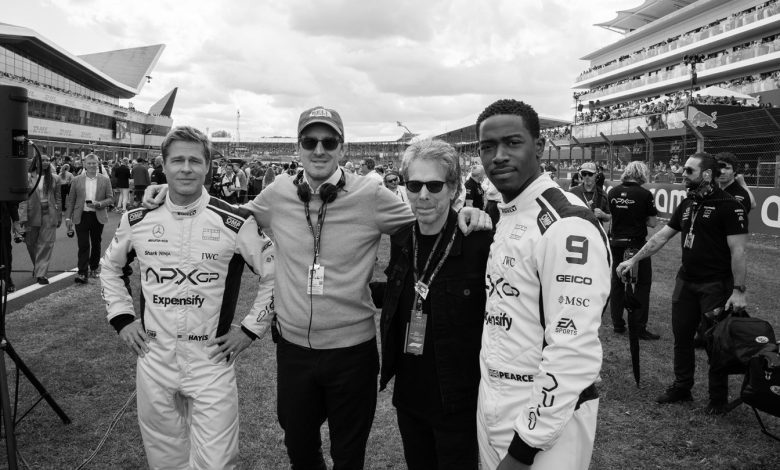
Pitt (left) and Kosinski (far right) talking to seven-time world champion Lewis Hamilton (second from right), who served as a producer on the film. Hamilton was instrumental in giving the filmmaking team access and insight into the sport, and assisted in departments from script to sound. Kosinski and Hamilton had met when Tom Cruise introduced them during Top Gun: Maverick, when Hamilton wanted to star in the film. He eventually passed on that opportunity because of his racing schedule.
Scott Garfield/Apple Studios
With Formula 1 signed on, Ehren Kruger, who had worked with Kosinski on Maverick, started writing the script. He embedded himself with the Mercedes F1 team for a race weekend and spent time at the factory talking to engineers, mechanics and strategists. “By the end of the first month of research, I felt I was writing a story that was as much about NASA engineering as it was about two drivers competing on the track,” Kruger says. “Hamilton was a critical part of the screenplay, adding a sense of realism to the story and screenplay by giving notes and adding his level of expertise of the sport.”
The champion driver worked overtime for his producer credit, going through the script beat by beat, advising on proper terminology. “I was selecting all the bits of sounds you get from different races on different parts of the track,” says Hamilton. “I was very meticulous about getting it right. What may seem like small details are actually a big component to the authenticity of the film and maintaining the integrity of the sport throughout.”
On a macro level, the script didn’t evolve much: It was always about two drivers on a last-place team. “It was a story about second chances,” producer Jeremy Kleiner says. “There was a human scale to the film, despite how technically complicated it was.”
Adds Kruger: “There was an early version where Sonny wasn’t driving right away and he was the team principal,” or the person who manages day-to-day operations. The final version had Hayes returning to the sport after a 30-year hiatus, hired by his former teammate Ruben (Javier Bardem) as the second driver alongside cocky rookie Joshua Pearce (Damson Idris), to help get the team out of last place.
It took a long time to find the right Joshua. Idris was recommended to Kosinski by casting director Lucy Bevan. “Damson demonstrated that he had the confidence, determination, charm, charisma and work ethic to play the role of Joshua,” says Bevan. “We took him to the track to test that he could handle the driving. After 140 laps, he told me it was my turn to get in the car; he had chutzpah!” She adds that Joshua was the most challenging role to cast because “there aren’t many young actors out there who are equipped to go toe-to-toe with Brad Pitt.”
For Idris, getting into Joshua’s mindset required “hanging out with all the stunt guys and the other drivers and learning how these drivers talk the talk,” Idris says. “I grew up playing football as well, so I know what it means to want to prove yourself in an athletic world so badly when there’s so much competition. I related to Joshua in that way.” He admits with a laugh, “just after reading the script, and learning about Joshua, I pathetically created a fake character on the F1 [racing video] game and won the championship.”
While Idris wanted Joshua to be a rookie, Kerry Condon felt that her character, Kate McKenna, team APXGP’s technical director, had to be a seasoned F1 veteran. “I think there’s an element of Kate that wants to prove the naysayers wrong. I’m sure a lot of people thought she wouldn’t be able to do this career because there aren’t many women in the F1 sport,” Condon says. She took inspiration from Formula 1 engineer Ruth Buscombe and Bernie Collins, an Irish strategy analyst for Sky Sports and F1TV who previously worked on the Aston Martin Team. “From them, I learned things like technical details my character would know, what she would jot down in her notebook and where she’d sit on the pit wall.”
The APXGP car was an F2 car, designed to look like a bigger, faster and more complex F1 car. The colors were chosen after the real F1 teams released their color visions for the season so that there would be no overlap in design with teams like McLaren or Ferrari.
Scott Garfield/Apple Studios
Pitt and Idris were put through a four-month training boot camp, working their way up from driving sports cars to the increasingly powerful (and expensive) Formula 4, 3, 2 and ultimately Formula 1 cars: “The first month was about learning to trust your car, knowing that it will stick to the ground, knowing it will brake,” Pitt explains. ” ‘Just trust the car’ became a constant mantra for me. This experience has been unlike any high I’ve ever known.”
Bruckheimer — who produced the 1990 Tom Cruise NASCAR movie Days of Thunder — watched Pitt and Idris become progressively more confident under the tutelage of the stunt drivers. “Lewis took them around the track, too, and showed them what and how to do it, and gave them exercises for their necks to withstand the Gs when they hit those corners.”
Cinematographer Claudio Miranda worked with Sony to build cameras small enough that Formula 1 would allow them to be placed on the cars. This image shows one such camera positioned over the tire on the APXGP car.
Scott Garfield/Apple Studios
The six vehicles built for the film were originally F2 cars. (To run an F1 car costs $250,000 a day, while an F2 car costs only $25,000 a day, notes Kosinski.) The crew had Mercedes’ F1 team — for which Hamilton drove until 2024 — extend them by 20 cm to make them the same length as an F1 car, then redid all the body work.
Pitt and Idris did much of the onscreen racing themselves, reaching speeds of up to 180 mph. “We set out to create the most visceral driving experience ever put on film, to show the forces in these cars, the high-speed corners, and even the combat with other drivers,” says Pitt. “To attain that authenticity, it had to be captured by letting the actors drive the cars.”
Hamilton watching F1 footage on monitors.
Scott Garfield/Apple Studios
Insuring one of biggest movie stars in the world to do something like this, however, was an uphill battle. “Entire days went into these conversations with an enormous number of people, and a lot of intelligence and expertise about determining, this is the speed at which it’s acceptable, and this is the speed at which it’s not,” producer Dede Gardner explains. Bruckheimer adds, “We had to convince the insurance company that the faster you go, the safer it is, because you need that downforce hitting those corners.” Initially, the insurers put a speed cap of 140 mph on the film.
The first race shot was at Silverstone Circuit, on Grand Prix weekend in July 2023. Pitt and Idris would show off what they had learned in training before a crowd of thousands. Since they could not drive during the real race, they shot their scenes on the track between the practice and qualifying race rounds during the three-day event, for as little as 10 to 20 minutes at a time. “We sent Brad and Damson out in our cars with cameras mounted on them, along with some other cars to surround them, and creating that racing environment with the crowds in the stands watching,” says Kosinski.
From left: Kosinski, Bruckheimer and Pitt looking at the APXGP car that Pitt would drive in the film. Tommy Hilfiger was one of the film’s sponsors, and the company’s logo was prominently displayed on the cars and the drivers’ suits.
Scott Garfield/Apple Studios
A key component was getting real F1 racers, like Max Verstappen and Charles Leclerc, to participate in the film. Hamilton helped convince them. “There was some hesitation within the sport initially — there’s never been a feature film shot during a racing season before, and adding a fictional 11th team was unprecedented,” he says. “Once everyone was on board, it was a collaboration between Formula 1, team owners, drivers and everyone involved to ensure it wouldn’t be disruptive to the season.”
After their short stints of filming on the track were over and it was time for the real race to begin, the cast and crew pulled back into the APXGP garage, wedged between the Ferrari and McLaren pit stops at the tracks. Production designer Ben Munro built a fully functioning garage (two of them, in fact) that could be broken down, packed up and sent to the eight countries that hosted production. It took three weeks to set up the garage the first time, Munro says; by the time he and his team got to Abu Dhabi to shoot the climactic final race, they could construct it in nine days.
Through the collaboration with Formula 1, Munro was able to talk directly to Mercedes, McLaren, Aston Martin and Atlassian Williams about their garage setups, “which is interesting because no other team ever gets to look at another team’s information. It’s all top secret, and you have spies,” Munro says. “We would look at the back of their garage, which is where the real information is, and we were also able to go to their headquarters and their wind tunnels. We had to sign NDAs with all the teams.”
Since they didn’t have F1 budgets to spend on their garage, the filmmakers “used slightly cheaper materials than they would use,” Munro says. “And we had to adhere to all the health and safety regulations because we couldn’t be held responsible for a fire happening in our garage during the Grand Prix.”
Scenes from APXGP headquarters were filmed at the real headquarters of Mercedes (for interiors), McLaren (for the exterior) and Williams (for its wind tunnel). Formula 1 let Kosinski and his team use their broadcast cameras — every F1 car has a tiny camera behind the driver’s head for the broadcast, and the filmmakers were allowed to replace several cameras in two or three cars with prototype cameras built by Apple. Additionally, the 30 F1 cameras around the track were modified to record in the format needed for the movie, resulting in at least 20 different angles of the race.
Kosinski reteamed with a lot of his collaborators from Top Gun: Maverick on F1, and used many similar techniques to make the film as authentic as possible. His medical engineering and design background proved handy in the making of the Apple Studios film.
Scott Garfield/Apple Studios
For other shots, cinematographer Claudio Miranda approached Sony to design cameras that were small enough to place on the cars, abiding by Formula 1’s weight restrictions. “We had to make sure we weren’t interfering in any of their normal activity,” Miranda says. “I was working a lot with Mercedes — all the camera mounts had to be approved, and we had to be really specific about where the cameras went. That took a lot of previsualization, figuring out what camera angles were going to work, and sending that to Mercedes and having them tell us what we can’t do. We also had to make sure Safety was happy with it, so if there is an accident, it all crumples up safely.”
At any given time, Miranda had three or four cameras on the car — up to nine if you count the other car cameras on the track. Together they could record profile shots, front-nose shots and over-the-tire shots, and could pan in any direction they needed thanks to Panavision’s custom motorized head. (For non-racing scenes, Miranda used a Sony Venice 2 camera.)
What resulted was 5,000 hours of footage for editor Stephen Mirrione to sift through. For comparison’s sake, he says he worked with just 400 hours’ worth on 2000’s Traffic, which earned him an Oscar. “Even on Maverick, it was something around 1,000 hours,” Mirrione says. “I’d be very surprised if I ever worked on something with this amount of material again.”
As any diehard Formula 1 fan will tell you, the scream of the engines is an essential part of the experience. With authenticity in mind, supervising sound editor Al Nelson was tasked with recording the sounds of the track. But he soon found that the cars Pitt and Idris drove weren’t cutting it.
“Those F2 cars don’t sound anything like the F1 cars,” says Nelson, “so we really had to throw away all the sound from the F2 production cars. We had to replace them all with new sounds we had to record. And the only way you can get those is by going to F1 and getting access to those cars.”
Nelson was given access to the pit lanes and tracks to get his mics up close to the engines. Mercedes allowed him to place tiny microphones and recorders in their car during qualifying rounds to capture the sounds from inside the car.
“I’d say the biggest challenge was making sure we got all the sounds right in the context of each scene,” adds Hamilton, whose ear is finely attuned to the music of Formula 1 racing.
Though Kosinski and his team relied as much as possible on practical effects, certain sequences required some digital magic. VFX supervisor Ryan Tudhope reveals there were about 2,500 special effects shots in F1. “We had two or three of our APXGP cars on the track, so in visual effects, we would replace those and add other cars in the background to make it feel like they were within the race,” he explains. For Sonny’s tire-to-tire battle with Hamilton in the film’s final race, for example, Hamilton’s car was inserted in postproduction. “We’d also have to do the reverse of the technique and add our cars into the footage supplied by the Formula 1 broadcast.”
VFX were also occasionally used to avoid wrecking a production car. “Some damage was too risky,” Tudhope says, “so we’d use a smaller vehicle, an F3 car, and a stunt driver would do the stunt and we would later replace that with our APXGP car.”
Joshua’s spectacular crash sequence in act two was a combination of practical and special effects. The car, one not fully built out, was rigged up and flung through the air. Rain and wet tracks were added on the Monza race track, and flames were increased for dramatic purposes.
To create Joshua’s car crash, a shell of a car was placed on a rig and flung through the air. The first time the team did it, the car didn’t eject far enough into the runoff. They amped up the power, and it flew into the woods — a happy accident that stayed in the movie’s final cut.
Scott Garfield/Apple Studios (2)
Sonny’s crash in Las Vegas was also mostly digital. “That was a simulated crash — we made the fence itself digital so that we could destroy it as the car hit it,” says Tudhope. FrameStore was the film’s lead VFX vendor, handling all of the races, while ILM handled the prologue’s Daytona sequence and some of the flashback work.
The final touch was adding Hans Zimmer’s kinetic score to the film. “This is my third race car movie [after Days of Thunder and Rush], but the main thing I could add to F1 was excitement, pace and a little bit of romanticism,” he says. “I wanted to do as much electronic music as possible, because I wanted the sounds to echo the sounds of the machines.”
The crash sequence for character Joshua Pearce (Idris) was based on a real crash that happened 10 years ago. A combination of practical and visual effects was used to launch the car off a rig and have it burst into flames. Idris was engulfed in the blaze. “Those were the biggest flames I’ve ever seen in my life,” Idris tells THR. “Brad and I were really in there.” To prepare, he spoke to the driver (he didn’t specify the driver’s name) who was involved in the historical crash (“I felt so bad, rewalking him through that trauma”). Idris adds that he lost weight so Pitt could legitimately carry the unconscious Joshua out of the burning car.
Scott Garfield/Apple Studios
Zimmer worked with the sound design team early on in the project to determine which race would be music-heavy, and which race would predominantly feature sound effects.
Ask the cast and crew what the difficult aspect of the shoot was, and you’re likely to get two answers. One was filming the Las Vegas race. The Sin City circuit is not up year-round, so the team wasn’t able to practice before filming on the track, which is considered especially dangerous (unlike most race tracks, it has no runoff areas between the road and the fence).
The other was the 2023 actors strike, which was announced just after filming began at Silverstone. The production suddenly lost Pitt, Condon, Bardem and Idris. But principal photography and sound recording continued at some races, including the Hungarian Grand Prix, and Kruger was able to storyboard the rest of the movie before the actors returned to work in January 2024.
F1: The Movie was about four years in the making, says Bruckheimer. “This is definitely the most complicated, most ambitious film I’ve done,” says Kosinski. Adds Pitt: “For me, the most surprising thing about the film is it isn’t just about winning the race or a title. It’s the spiritual component of it all. What Sonny achieves in the end is a moment of transcendence, and that truly moves me.”
But maybe there is more of Sonny’s story to tell: Talks of a sequel are already ongoing.
“It’s fun to think about what circumstances could bring him back into the world of Formula 1,” says Kosinski. “We’re in the early stages, but it would be fun to go back in a few years.”
HiCelebNews online magazine publishes interesting content every day in the movies section of the entertainment category. Follow us to read the latest news.