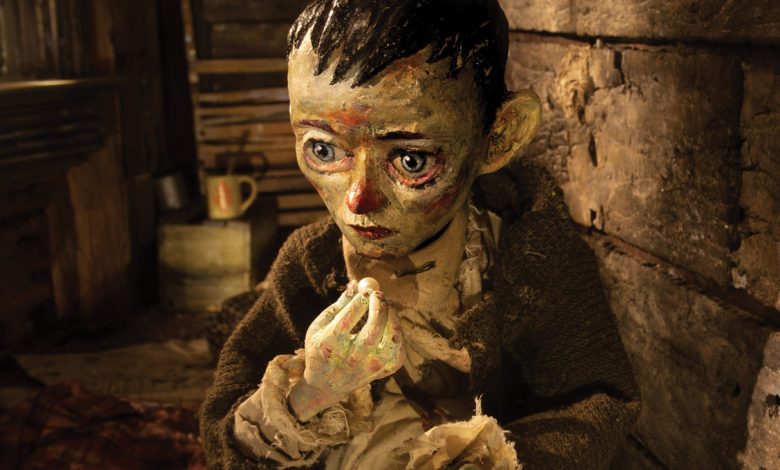
For Chris Lavis and Maciek Szczerbowski, directors of the Oscar- and Annie Awards-nominated animated short film The Girl Who Cried Pearls, one man’s trash became miniature set materials for their stop-motion film that captures Montreal in the present and at the dawn of the 20th century.
“People don’t necessarily appreciate when something is broken or dirty, it isn’t only that; it speaks to a history as it seems to carry, locked inside of itself, memories of another time,” Szczerbowski tells THR about recycling street waste to bring texture and authenticity to a tiny real-world set, where in reality, everything is fake.




“There are no real, found locations. The light is not coming from the sun. Everything is a facsimile. So the more real material you stick into the image, the more it subconsciously works on an audience to make you forget about that illusion and buy it as reality,” he adds.
Such trickery to assign great value to low-worth materials also underpins the surprise ending for The Girl Who Cried Pearls, which follows a poor boy falling in love with a girl overwhelmed by sorrow to the point her tears turn into pearls. The boy collects and sells the pearls for gain to a ruthless pawnbroker, even as he must choose between love or fortune. The film was nominated in the best short subject category, but lost to Snow Bear.
The National Film Board of Canada filmmakers also opted to digitally replace the mouths of their hand-sculpted puppets to seamlessly match the sound of their dialogue and narration.
“If it felt like they were CG mouths on top of a handcrafted puppet, then the whole illusion, the whole romance of stop-motion, of handcrafted work, would be shattered,” Lavis explains.
And to avoid the appearance of simple wooden dolls as characters, Lavis and Szczerbowski had the heads of their puppets designed to look like old wood with multilayered oil painting that in reality are silicon molds placed on white plastic.
The Montreal filmmakers also eschewed traditional storyboards for their animated film in favor of actors being invited into a studio to help shape their evolving script.
During rehearsals with handheld cameras and angles, the actors were encouraged to capture with high-energy gestures and behaviors how the stop-motion puppets may eventually be shown in motion at 24 frames per second from their miniature set.
“We don’t treat those actors like puppets. We want our puppets to act like people, and the best way to make that happen is to work with great performances,” Lavis adds of the actors being encouraged to be loose and playful in the studio, noting that the stop-motion animation to follow, by contrast, would be precise and painstaking.
The animated short features Colm Feore as the narrator, with Patrick Watson doing the music and Brigitte Henry serving as artistic director.
The Oscar nomination for The Girl Who Cried Pearls marks the second for Lavis and Szczerbowski, after their 2007 short Madame Tutli-Putli earned them their first. And, as with their first trip to the Oscars, they feel like winners already.
“We didn’t come home from the last Oscars we went to as people who lost. We accomplished something beyond our wildest dreams by even being invited,” Szczerbowski says.
Lavis adds that they want to represent their country and the National Film Board of Canada, which has put its faith in their animated short films, and the tight creative community in Montreal from which they draw inspiration and collaborators.
“This is one of those cities that should exist in the world’s imagination, and one of our goals is to add a tiny bit of mythology to the streets that we walk through, the way that Hans Christian Andersen mythologized Copenhagen or the way New York romanticizes itself,” says Lavis.
This story appeared in the Feb. 23 issue of The Hollywood Reporter magazine. Click here to subscribe.
HiCelebNews online magazine publishes interesting content every day in the movies section of the entertainment category. Follow us to read the latest news.