When Silvia Cruz, who founded and runs the Brazilian distribution company Vitrine Filmes, started pitching a local new movie called The Secret Agent to exhibitors, she met a ton of skepticism. “They said, ‘Whoa, Silvia, are you sure you’re going to go for it?’” Cruz recalls. The film may have starred one of the country’s biggest stars (Wagner Moura) and hailed from a proven director (Kleber Mendonça Filho), but the nonlinear narrative and 161-minute runtime sounded, to many, like a recipe for commercial failure. Cruz believed in the movie. But she knew these theater-owners to often be right about what would draw a crowd. “I had to prove that the audience was ready,” she says.
She did just that. Mounted on a budget of approximately $5 million, The Secret Agent has sold more than 2.45 million admissions nationally — theatrical numbers are not reported by gross in Brazil, but if translated to standard American ticket prices, that would equal over $40 million — and remained in the top five of the country’s box-office through 16 weeks of release. It premiered to a prize-winning launch at the Cannes Film Festival before going on to receive four Oscar nominations, becoming the second consecutive Brazilian film to be nominated for both best picture and best international film. Its predecessor in that regard, I’m Still Here, similarly emerged as a commercial phenomenon back home.





Wagner Moura in Kleber Mendonça Filho’s The Secret Agent.
Victor Juca/Neon
These movies vary wildly in tone and style, but both urgently and movingly revisit the height of the Brazilian military dictatorship during the 1970s — crucial context, since both also emerged from a more recent repressive moment in Brazilian life, the reign of Jair Bolsonaro from 2019-2022. “This film could have never been shot during those four years,” Walter Salles, the director of I’m Still Here, told me last year. Censorship practices were strong and consistent. Then came the election of progressive Luiz Inácio Lula da Silva, who’d previously served as president two decades earlier, and who’s worked to reinstate major cultural infrastructure. If the prospects for Brazilian films tend to be tied to their political moment, the industry is now in a state of rebuilding and transition. The buoying provided by two seismically successful, fiercely independent dramas cannot be understated.
“The market for something we’d built over 20 years was shut down in four [years] — and we are recovering,” says Rodrigo Teixeira, the Oscar-nominated Brazilian producer of I’m Still Here who works all over the world. “But what we’ve done in the first three years of this new government is amazing.”
***
A vibrant cinema culture is, in a sense, intrinsic to Brazil. “It’s a constitutional right,” Secret Agent star Moura says. “In the Brazilian Constitution, it’s written that the government has to provide culture to the people.” His Secret Agent director, Mendonça Filho, adds where things stand currently: “We’re back at this place where we should never have left: Getting public funds for artistic expression and for the distribution of works of art made by Brazilian artists.”
Moura heard stories growing up of two movie theaters in town squares all over Brazilian cities, big and small, back in the ‘50s and ‘60s. “Going to the movies were part of the daily lives of people,” he says. Adolpho Veloso, the Oscar-nominated cinematographer of Train Dreams who was born in São Paulo, adds, “Movies were a huge part of how I grew up.” He didn’t come from a family of artists, but at around 13, was inspired to pursue filmmaking as a career after the massive success of Fernando Meirelles’s City of God (2002), which received four Oscar nominations. “To see Brazilians and people like me occupying spaces that I didn’t think was necessarily possible made me believe that was possible,” he says. Veloso has already witnessed several waves of censorship, but those breakouts kept hope alive: “We’ve had governments just intervene and stop all the funding and all the incentives…. It’s amazing to see how Brazilian cinema survives despite all the curveballs.”
Commercially, though, the volatility made its impact — no doubt worsened by global disruptions like the rise of streaming and the pandemic. “If you made a good film, a prestigious film, it would never be popular — and if you made a popular film, it would most likely be a television-like comedy. I just could not understand how we ended up in that situation,” Mendonça Filho says.
Fernanda Torres after winning the Golden Globe for I’m Still Here
Robyn Beck / AFP via Getty Images
Cruz argues that distribution of Brazilian cinema has proven especially challenging as many exhibitors became increasingly focused on American films and broad comedies. “There is this intermediary, the movie theater — they have to believe to put on your film,” she says. Adds Teixeira: “The problem with Brazilian cinema for years is that Brazilian cinema is like a genre — in Brazil, we have horror, we have action and we have Brazilian cinema.” Local films have been treated as a niche — which becomes a kind of self-fulfilling prophecy as fewer and fewer secure wide releases.
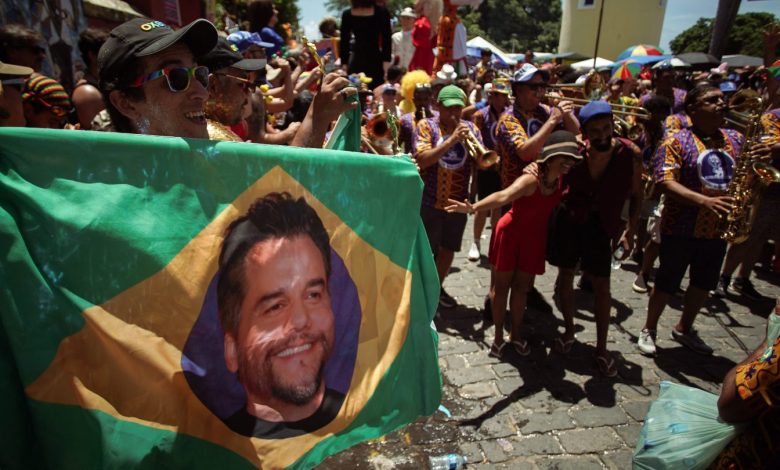
Here’s where things are changing — and fast: For the last two years, the share of Brazilian films at the Brazilian box office has been more than triple what it was in 2023. (“It’s still very far from where we should be,” Mendonça Filho cautions.) The Secret Agent and I’m Still Here are not the sole success stories, but they are the most visible. This year’s Oscar nominations, for instance, pushed Secret Agent from No. 9 to No. 3 in Brazil in a single week, to say nothing of the ecstatic Carnival homages to the film that took place all over the country some weeks later.
“This is something bigger than just box office,” Cruz says. Not that the box office isn’t a huge factor: Salles and Moura are major advocates of extensive theatrical windows, and stayed off digital for their first several months on the big screen. “We’re seeing this incredibly old fashioned theatrical success story,” Mendonça Filho says.
Moura has noticed this all triggering backlash. “On the far right, man, they’re very, very efficient in demonizing artists in Brazil,” he says. “If you go to social media, you’re going to see lots of YouTubers, whatever you call these people, saying that Kleber and I are part of this group of artists taking advantage of public funding to get money for ourselves, which is so absurd. It really breaks my heart to see these narratives taking off. People really buy that.”
Then there’s the other side: The passion coming out of Brazil has not only become the stuff of legend for Oscar-campaign watchers here in the U.S., but a source of vital fuel for an artist like Moura, who hadn’t acted in a Brazilian film in over a decade before The Secret Agent came his way. “Brazilians seeing themselves like this creates identity, this creates self-esteem, this creates a sense of understanding of what kind of people we are,” he says. “When I see Brazilians showing pride, dressing up like Dona Sebastiana in the film in the pure Brazilian Carnival fashion, I think it’s just fucking beautiful. It makes me go, ‘Okay, fuck it. I’ll keep fighting for this.’”
***
Moura’s break from acting in his native tongue could be attributed to many factors, from politics to his own career boom in the U.S. As for now? “I want to work in Brazil at least once a year,” he says. In April, he’ll shoot a remake of Abbas Kiarostami’s Taste of Cherry in Brazil, and he’s developing a new project with his Lower City director Sérgio Machado. “The thing I wish I had more access to is the new filmmakers,” Moura adds. “I know they’re there.”
Last month, Moura presented the Spirit Award for best cinematography to Veloso (and later hosted a reception for Train Dreams), both expressing ebullience as they navigate awards season together. “It is amazing to be with other Brazilians, and to receive an award from Wagner Moura himself, who is an idol, a hero, a person I admire so much — all those things are quite surreal and amazing,” Veloso says.
Wagner Moura presenting the best cinematography Spirit Award to Train Dreams DP Adolpho Veloso
Kevin Winter/Getty Images
These pillars of Brazilian film are operating on a global scale — Teixeira estimates more than two thirds of his producing work now happens internationally, while Velosa has seen his career flourish away from home. But all express a shared excitement at the possibilities in Brazil, with a reengaged audience and a rising crop of filmmakers like Pedro Freire and Carolina Markowicz. “Now people are looking at Brazil differently: What’s happening there? Who is the next Kleber? Who is the next Walter?” Teixeira says. “I think we have a new wave.”
The common fear is that another political shift will roll back these rapid, major gains. “We’ve got to keep existing, we’ve got to keep producing good movies, we’ve got to produce everything,” says The Secret Agent’s Oscar-nominated casting director, Gabriel Domingues. Teixeira is more blunt: “We depend on tax incentives. Don’t kill that.”
And of course, movies like I’m Still Here and The Secret Agent are making money — proving to skittish theater owners that there’s a genuine market for challenging, provocative art films. Cruz sees that impact on the ground: “People are talking about Brazilian films and they want to see Brazilian films. They want to go to pay for a ticket to see a Brazilian film! Investors are looking at all of this. This is going to change lots of things.” She’s even noticing more trailers for Brazilian films now playing in these same theaters.
“Hopefully everything that is happening now — with international recognition — turns the eyes to Brazil in a way to bring more investment,” Veloso adds. “We can reduce a lot of prejudice that exists inside Brazil itself, to inform people more on how important it is to produce culture and produce art — and how helpful that is to the image of a country, how much investment that can bring in all possible ways.”
As for the image part, Veloso knows first hand how much of an impact visibility can have: “Hopefully what happened last year with I’m Still Here, and what’s happening this year with Secret Agent and so many other Brazilian films, can be similar to how, one day, City of God was important to me as an inspiration,” he says. “I saw, ‘Okay, if Brazilians and people like me are occupying those spaces, maybe I can too.’”
HiCelebNews online magazine publishes interesting content every day in the movies section of the entertainment category. Follow us to read the latest news.