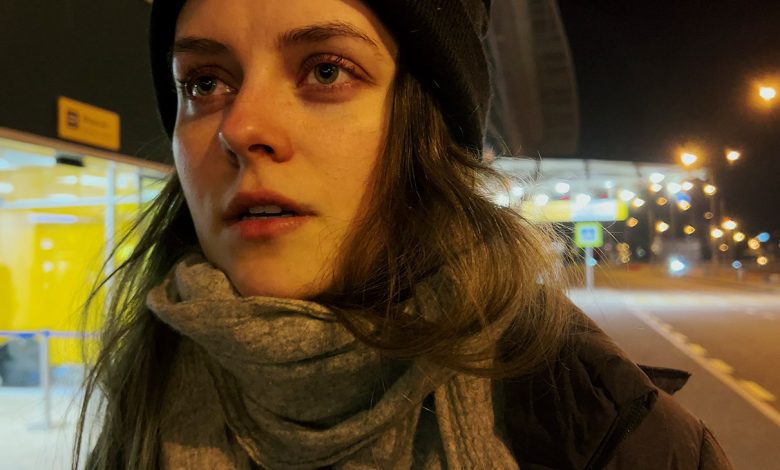
In an unusually competitive documentary landscape this awards season — featuring the return of an Oscar-winning Ukrainian filmmaker from a warzone, a critical and audience phenomenon that reached millions via Netflix — one especially unlikely contender has still managed to stand out. With her first documentary feature in nearly 30 years, Julia Loktev (The Loneliest Planet) is striking a chord with My Undesirable Friends: Part I — Last Air in Moscow, a érité portrait of journalists in Russia as their country launches a war with Ukraine. In just under five and a half hours of runtime, these subjects feel the tightening, irreversible grip of authoritarianism forcing them out of their home — but they still live life, sharing meals and making jokes, and taking things day by day. Taken together, My Undesirable Friends weaves an epic tapestry of humanity.
The film premiered to strong reviews at the 2024 New York Film Festival, but in the year-plus since, has been unable to find a distributor. (It was self-distributed to qualify for Oscars consideration this cycle.) In the time since, My Undesirable Friends has won top documentary prizes from the New York Film Critics’ Circle and other regional groups, been shortlisted for the best doc Oscar, and dominated publications’ year-end best-of lists among nonfiction movies. Accordingly, just as Loktev finishes work on her second, equally lengthy installment, the film’s fortunes may soon change. “We should hopefully have news soon,” Loktev tells The Hollywood Reporter.
But the road has not been easy — Loktev has had miniscule funds to work with, compared with her competitors, and knows the challenge of getting voters to see the longest film in the running. “When you see on paper, ‘Oh, it’s a five and a half hour film about Russian journalists,’ you go, ‘Scary, I’m not sure about that,’” she says. “But then more people watch it, and the more people actually talk about what the experience of it is, the word starts spreading.”
See below for THR’s Q&A with Loktev.
I’m curious how you thought about the way this would be released, given the length. Did an episodic format ever come up, especially with the existing chapter structure? What was it like planning to get it out into the world?
The whole making of the film has been this crazy endeavor. I shot it alone with an iPhone, no crew, and basically have been the director, producer, cinematographer — and I had a co-editor and an assistant editor, so literally most of the film has been three people. That’s it. I started filming a film in Russia four months before the full scale war, when nobody knew that Russia would start this horrific war in Ukraine, and then history just started unrolling super fast, and I was there and filming it all. There was no time to think; I just had to keep filming. I was there during this historic event and I had a tiny seed development grant. There was no planning.
I continued to film all the characters in exile and then I just thought, I have this incredible historic footage, captured through people you get to know as characters the way you would in a fiction film. I let the film become what it needs to be rather than have somebody tell me what it should be. There was a point very early in the editing process that I walked away from equity that would’ve funded the whole film.
Really? Wow.
It would’ve imposed a format on it. “It’s going to be a feature-length film.” I said, “I need to see how to shape this. I have this incredible footage and I want it to tell me what the film should be and I want to be true to the actual material and true to the events.” So I got some grants and just kept editing to make it what it needs to be. It was obvious it would’ve been an easier path to go and find a place and have somebody telling me exactly what to make it into, but I owed it to the story to let it be what it needed to become.
As you were starting to put this together, what told you that this was the final format, a five-plus-hour film? It’s not typical, obviously, even if you had so much footage to work with.
And it’s an enormous amount of story — it’s not just footage. I mean you can condense all the footage you want to. I was basically there to capture this historic exodus from this moment, from when it’s still possible to work as the opposition in Russia and be an independent journalist in this authoritarian society and fight back, to when everybody realizes that to continue to do this work, we have to flee this country. A million people left. What the film does, I think, is it lets you live through it with people. I come from fiction — I filmed them like they were characters in a fiction film that you live through it with them, feel through it with them. It’s not experts explaining things. It’s just really being in the moment.
If you make it into an hour and a half film or a two hour film, yes, you could do it and it would be this condensed version where you get the information — and you can get the information in a New York Times article, you can find the information elsewhere. But to feel what it feels like to live through it with characters that you could hopefully fall in love with, you needed to have time to understand that. It’s a very long film, but a super fast-cut film — it’s not a meditative film at all. You’re having trouble sometimes keeping up reading the subtitles so fast, but it’s dense.
And I mean, it’s not a series because no streamer wanted it. (Laughs) I would’ve had a lot more money to make it if they did — and a lot more money now for an awards campaign, God knows. But at the same time, I question these distinctions because if you think about it, like all the great Russian novels, Crime and Punishment and War and Peace, not to mention the Charles Dickens novels or Ulysses, were all released in serialized forms and magazines first and then became novels. We don’t question, now, is War and Peace a novel?
The beauty of the film is that this feeling of real life happening, but you are still a filmmaker and there is a certain rigor to your approach. Did the project formally evolve at all, the deeper you got into it?
I just tried to work really organically, even in the shooting: Something is happening in front of you and you’re just trying to keep up and frame the shot. Because I do come from fiction, I don’t know if I filmed them any differently than I would an actor giving a great performance, except it happens to be true in their real life and all the more tragic for that.
One of the things that I learned so much from this as a filmmaker is that people are so much more complicated and so much more contradictory and interesting than I could ever write them, to be honest. When we write fiction, so often people go a little bit more on the nose — if people are going through a tragic moment, they stay in that tragic moment. What I constantly observed with people here is this shift from the most terrible horrible things, to sudden humor, back to the terrible horrible things — very inappropriately and wonderfully and in a way that I’d think, “Wow, I wish I could write like this.” This taught me so much in having to observe in a very focused way as you’re filming, and seeing people joke in the middle of their lives falling apart.
What was your relationship to the subjects like? You’re very present in the movie as the one with the camera, and as you mentioned, they trusted you implicitly to do this.
I knew Anna Nemzer, who leads us into this world. She knew all the other characters in some way professionally or as peripheral acquaintances, friends to different degrees. She brought me into this world as a trusted person. I was born in Russia, and so Russian is the language I speak to my mom, even though I grew up in the States. It would be a completely different relationship if I was coming in without that. But people opened up to me very quickly, very instantly. We had a rapport, and then over the course of filming we became friends. That’s a huge part of the film because you experience it with me — you literally meet a lot of these characters as I’m meeting them. You get to know them and hopefully they become your desirable friends as well as mine. They’re “undesirable” only because that’s what the Russian government has marked them as. That’s an actual legal category in Russia where they have marked most journalist organizations and most of civil society as “undesirable organizations.” They’re undesirable to their authoritarian project.
How have you experienced screening the film over the last few months, getting it out there in an awards context?
Oh, Jesus, my favorite subject — the campaign. (Laughs) We’re trying to do our best. When I heard what the streamers spend on their films, my jaw dropped. We can only do a tiny fraction of what is supposedly considered necessary to do. We are just doing our best on a micro budget. It’s really, really difficult because you’re sitting there getting bombarded with things from the larger distributors. You’re feeling small and insignificant and feeling FOMO when you have no budget to do anything about it. It’s unfortunate that that’s how things are, but it is how things are and all you can do is your best. We just want the film to reach an audience. That’s what we care about.
It must feel like a nice bit of vindication, then, when you hit the Oscars short list or pick up these critics’ awards.
Definitely. I mean, it’s a tougher road. And $1 or $2 million for a campaign couldn’t hurt.
Can I ask what you are working with in terms of money?
Oh God, it’s a fraction. We’re just trying to extract so little — like, well, I shouldn’t say that in print. But it’s not like there’s some distributor paying for it. In all honesty, it’s production money that was supposed to eventually pay me, and literally the characters in the film. I didn’t want to do it, to be honest; I was like, “This seems so crazy to enter into this.” And it was characters from the film who said to me, “Listen, try to give the film the best chance possible. Let’s do a little bit of something.”
Laura Poitras did an event with us at my house and I went to Tashkent Supermarket, which has all this post-Soviet food in New York. I got a bunch of snacks. I put them on a table. There were no waiters with tiny hors d’oeuvres. That’s what we can do. We’ve had people be very kind. Laura’s been supportive, and I love her film [Cover-Up] as well.
The film’s portrait of living under creeping authoritarianism has certainly resonated in the U.S., as it’s a relevant topic these days. Have you noticed that?
How people perceive the film has shifted so much since we opened at the New York Film Festival [in 2024]. It all felt so far away then. It’s just transformed so much. What’s interesting to me is it’s not just about the larger picture, but very specific details in the film that were specific to something happening in Russia that suddenly took on resonance. Somebody has a throwaway joke about when they shut down Russia’s biggest comedy show. It wasn’t planted there. Or when Russia shuts down its oldest human rights organization, which was dedicated to preserving the memory of political repression and addressing political repression in the current times, the judge says, “Why must we talk about our unpleasant history? We must be proud.” Of course, I’m watching Trump with the Smithsonian now and saying, “Why must we talk about unpleasant things like slavery?”
Last night I read about the 60 Minutes piece being pulled. The crackdown on journalism with Russia, they didn’t go straight for charging journalists with treason and extremism or terrorism. They started with economic pressure, pulling advertisements or threatening to sue journalists for libel — various kinds of strong-arm techniques that all looked perfectly so-called “reasonable.”
One of the nicest things that I’ve heard from people is that it gives them a way of processing the current moment because we’re living through something unprecedented and we don’t know how to deal with it emotionally. There is this cognitive dissonance or horrible things happening in our country. Meanwhile, the fabric of many lives looks completely normal and for the most part undisturbed. If you look around your neighborhood, it looks more or less the same. Life looks nice, and yet what’s actually happening is horrific. That’s really what dystopian societies look like. They don’t look like V for Vendetta. Authoritarianism is really good for some people, and for the rest of us, it is this cognitive dissonance where parts of our lives remain intact and seem very normal, and meanwhile, people are being snatched into unmarked vans by masked men.
Where are you with Part 2?
I’ve edited four out of the five chapters, and so now I have to edit the last one. I’m in the process of doing that now. It’s scary, but I am being given a little bit of hope. I’ve spent four years with these people, and in a way I’m kind of having separation anxiety of what will happen when I finish that. But if the Vladimir Putin regime ever falls, we’re going to go back and make a third installment. We may be very, very old by then because it’s not going to go well probably right after.
Have you stopped filming? Do you know where this story ends for now, as a film?
I haven’t actually stopped filming. I’m not actively filming a lot, but as I’m meditating on the last chapter, I want to end as closely to where we leave off as possible because the story keeps unfolding. I’m pretty sure I know what that last shot will be. Once I get three quarters of the way or 80% of the way with editing this chapter, I want to film that one thing. Probably, that’s when we’ll stop.
HiCelebNews online magazine publishes interesting content every day in the movies section of the entertainment category. Follow us to read the latest news.