The Godfather shot in New York from late March to early July. From virtually the first week, director Francis Ford Coppola feared he’d lose his job. Paramount expected a cheap little crime picture, just the kind of job Francis couldn’t bring himself to perform. The studio hovered over him. They hadn’t liked his cast, and they didn’t like what they saw in the dailies. Allegations that the film was anti-Italian, encouraged by the New York mob, made them nervous.
“I was 29,” Francis remembered later. “I had no power. They could easily push me around, which they did and tried to.”



On Thursday, April 15, 1971, Francis sat at home with his wife, Ellie, who was nine months pregnant, and Marty Scorsese, back in New York to visit family, and turned the TV to NBC to watch the Academy Awards. Two hours into the show, the actors Sarah Miles and George Segal walked to the dais and announced the winners for best original screenplay: for Patton, Francis Coppola and Edmund North. It was Francis’ first Oscar. He hadn’t gone to the ceremony because he thought, if he left New York, someone else would be directing The Godfather by the time he came back.

George C. Scott in Patton, for which Coppola won best screenplay in 1971.
20th Century Fox Film Corp./Courtesy Everett Collection
“How are they going to fire you now?” Marty asked, beaming.
Francis started believing in his film. He wanted so badly for it to be great, it was like his life depended on it. When The Godfather wrapped in August, after three and a half months in New York and a brief stint in Sicily, Francis dove straight into cutting, with Peter Zinner and William Reynolds as his editors, and Walter Murch, with whom he’d grown close, as his sound mixer. Even then, Murch says, “there was a big trough period where it looked like the film was not going to work. The studio kept hammering, and Francis was resisting … The feeling on The Godfather was: This is long and dark and self-indulgent.”
Paramount head Robert Evans, meanwhile, was pushing Francis not to give up on The Godfather. “You don’t know what you’ve got, Francis,” Evans told him enthusiastically in the final days. “We’ve got a shot at being remembered.”
Coppola with his father, Carmine Coppola; his sister, Talia Shire; and wife, Eleanor Coppola, at the Governors Ball in 1975.
Long Photography/The Academy/Getty Images
By now, Francis was exhausted.
“I’m tired of listening to your hype, Evans,” he moaned.
Evans stood his ground. He thought The Godfather could be one of the biggest films ever, make over $50 million.
“Only Gone With the Wind and The Sound of Music hit those numbers,” Francis argued.
“Yeah, and we will too,” Evans said, “if you don’t fuck it up.”
“And you’ll buy me a Mercedes, too, if it does, huh?”
Raise or fold. Evans looked into Francis’ eyes.
“You’re damn right I will,” he said.
Coppola on the NYC set of The Godfather Part II.
Gerald Israel/Hulton Archive/Getty Images
The Godfather turned out to be far bigger than even Evans had predicted. The five cinemas first showing the film in New York were so overwhelmed by demand that they ran the picture around the clock. Local businesses complained to the press about long lines blocking access to their storefronts. By the time it opened in L.A. on March 22, 1972, the movie had already grossed $13 million — twice its shooting budget — in a single week, in a single city. On March 24, The Godfather “went wide,” opening in cinemas across the rest of the U.S., and the pattern repeated itself. It packed every house. It had legs. And over and over, critics, writers, columnists and scholars praised Francis: for his seeming control of every frame, for turning popular entertainment into great tragedy, for blurring the boundary between genre picture and work of art. Francis had done what no other American director of his generation had yet managed: He had made a film that excited and titillated as entertainment but also pushed the bounds of the medium. His picture had “touched greatness” — as Henry Kissinger put it — and also outgrossed every entertainment picture in memory.
Henry Kissinger, producer Robert Evans and his wife, Ali MacGraw, at the New York premiere of The Godfather, in 1972.
Archive Photoes/Getty Images
In the summer, on the exact day The Godfather passed $50 million in revenue, Francis and George Lucas went down to the nearest Mercedes dealership and bought a dark blue 1972 Mercedes-Benz 600 Pullman — the same model, Francis boasted, as the pope’s. The car cost roughly $38,000 — about $200,000 in 2025 dollars. Francis told the salesman to send the bill to Robert Evans at Paramount Pictures.
Francis directed The Conversation, released in April 1974, then turned around The Godfather Part II — his sequel to the original — so quickly it came out at Christmas. It didn’t match the record take of the first installment, though it still became Paramount’s biggest moneymaker of the year. When Oscar nominations were announced in late February 1975, Francis was nominated for best director, for The Godfather Part II; for both best original screenplay, for The Conversation, and best adapted screenplay, for The Godfather Part II; and for best picture twice, for both The Conversation and The Godfather Part II. Altogether, his two films garnered 14 nominations. His sister, Talia Shire, was nominated for best supporting actress. His father, Carmine, with Nino Rota, was nominated for best original score. Three of the five nominations for best supporting actor went to actors from The Godfather Part II. The last film to have achieved that feat had been the first Godfather; no film has received three actor nominations in the same category since. No director in 32 years had had two movies nominated for best picture in the same year. It was the third year in a row that at least one picture Francis had produced was nominated for best picture, after Lucas’ American Graffiti the year before and The Godfather the year before that, and the second time in three years that he had also been nominated for both writing and directing. No filmmaker in history had ever had such a run, let alone one who refused to even live in L.A.
Salvatore Corsitto, James Caan and Marlon Brando in 1972’s The Godfather.
Courtesy Everett Collection
Al Pacino in The Godfather Part II
Courtesy Everett Collection
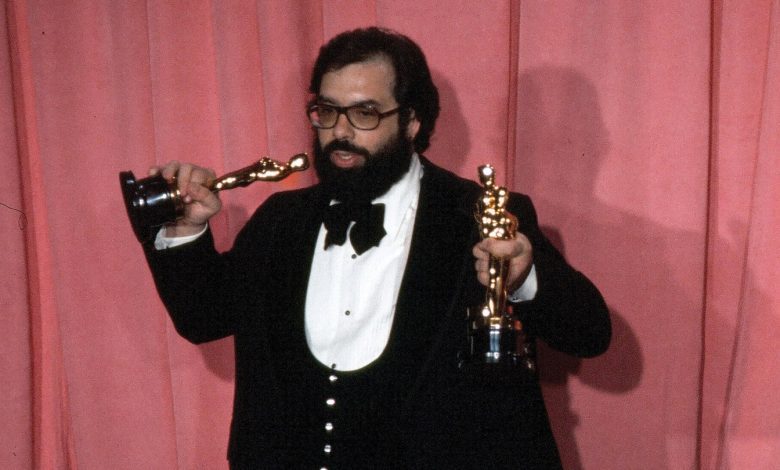
Francis turned 36 on April 7, 1975. The Oscar ceremony took place the next day at the Dorothy Chandler Pavilion in downtown L.A. Before the event began, Francis, waiting at the back of the auditorium, unexpectedly found himself standing alongside Robert Evans. In his last year as head of Paramount — he was stepping down to become an independent producer — Evans had earned the studio a total of 43 nods, more than any one studio had ever received in a single year. He was nominated for best picture personally, for producing Roman Polanski’s Chinatown, tied with Godfather Part II for most nominations at 11 apiece, putting him in direct competition with Francis, who had humiliated him when he had asked, and received, the right to ban Evans from his set. Francis said it was a question of creative freedom. Evans, to the end of his days, said Francis just wanted to hog the acclaim to himself.
They stood awkwardly side by side in their tuxedos.
“It’s your night,” Francis said.
“No, Francis, it’s yours,” Evans answered.
They hated each other’s guts.
Unfriendly telegrams from 1983 attesting to the bad blood between Evans and Coppola over credit for The Godfather.
FREDERIC J. BROWN/AFP/Getty Images
Robert De Niro won the first award of the evening — best supporting actor, for his portrayal of the young Vito Corleone. Francis took the stage to accept it on the actor’s behalf. In his seat, Evans smiled politely. Halfway through the night, Francis’ father accepted his statuette for best score, shared with Rota, soon followed by Dean Tavoularis, winner for best art direction. Entering the final stretch, The Godfather Part II had collected three awards; Chinatown, none. Goldie Hawn and filmmaker Robert Wise took to the stage and announced Francis as the winner for best director. Then writer James Michener immediately called Francis’ name again, alongside Mario Puzo’s, as winner for best adapted screenplay. Robert Towne, who had written Chinatown, collected the award for best original screenplay. Jack Nicholson, star of Polanski’s film, and Al Pacino, star of Coppola’s, split the vote for best actor and lost to Art Carney, winner for the minor dramedy Harry and Tonto. Scorsese was onstage next, accepting the best actress statuette on behalf of Ellen Burstyn for Alice Doesn’t Live Here Anymore.
Coppola on the set of The Godfather, on the bed in which film producer Jack Woltz finds a severed horse head.
Courtesy Everett Collection
All that was left was best picture. Evans still held out hope. His good friend Warren Beatty, who had never presented a prize at the event before, had accepted to hand out the final statuette, in the certainty his pal Evans would be the winner. Beatty was as well-connected as anyone. He was never wrong. Smiling, Beatty walked up to the podium and opened his envelope.
“Francis Ford Coppola,” he said, “The Godfather Part II.“
Evans, stony-faced, didn’t applaud.
Francis hopped to the stage and motioned to his co-producers, Fred Roos and Gray Frederickson, to give their speeches first. Then Francis took his turn. “Thank you again,” he said. “We tried to make a film that would be a really good film, and, uh, and thank you very much.” He burst into a huge, incredulous smile and shook the golden statuette by the side of his head. “Thank you.”
After the show, he made sure to find Evans. “I’ve lost all the joy of winning,” Francis told the man who had, technically, greenlit his movie. He set his face into a disingenuously pained expression and apologized for “forgetting” to mention Evans in his speech. And then he walked away, his three gleaming Oscars clutched tightly in his large hands.
Evans, who as Paramount studio head had championed Coppola, had become his rival by 1975, when Chinatown (which Evans produced) lost best picture to Godfather Part II.
Courtesy Everett Collection
From The Last Kings of Hollywood: Coppola, Lucas, Spielberg — and the Battle for the Soul of American Cinema, by Paul Fischer. Copyright © 2026 by the author and reprinted with permission of Celadon Books, a division of Macmillan Publishing Group LLC.
This story appeared in the March 11 issue of The Hollywood Reporter magazine. Click here to subscribe.
HiCelebNews online magazine publishes interesting content every day in the movies section of the entertainment category. Follow us to read the latest news.