I’ll admit it: I was Nixon pilled.
I was in high school, circa 2000, and watching through the movies that John Williams had scored — at least the ones on DVD I could borrow from my local library. That journey (which eventually culminated in my writing his biography) took me off the well-beaten path of Star Wars and Spielberg, and into a trio of films that Williams scored for Oliver Stone: Born on the Fourth of July, JFK and Nixon.




Striding into theaters 30 years ago on Dec. 20, 1995, Nixon pissed off the recently deceased President’s family (his daughters called it “character assassination”) and it somewhat divided critics—although Hollywood Reporter’s Duane Byrge praised it as “an insightfully shrewd psychological portrait of the only president to resign” and a “brilliant panorama of the political landscape through Nixon’s rise and fall.” Roger Ebert was enraptured. “There’s something almost majestic about the process: As Nixon goes down in this film, there is no gloating, but a watery sigh, as of a great ship sinking,” Ebert wrote in his review for the Chicago Sun-Times. “The movie does not apologize for Nixon, and holds him accountable for the disgrace he brought to the presidency. But it is not without compassion for this devious and complex man, and I felt a certain empathy: There, but for the grace of God, go we.”
It was the compassion that startled me. This was a spectre from well before my time whom I knew only as a universally despised and mocked cartoon villain, a bulbous Halloween mask with a funny, jowly voice. And at first, Stone’s film seems like it is going to be a monster movie about the American Antichrist. It even opens with the famous Bible verse, “For what is a man profited, if he shall gain the whole world, and lose his own soul?” which is then followed by sinister scenes of the men planning the Watergate break-in and shots of Nixon, drunk and slurring in the White House on a dark and stormy night.
But Nixon is no hit job. It’s not a smug farce that wears hatred on its sleeve, à la Adam McKay’s Vice. This film has more in common with Citizen Kane (Stone modeled his establishing shot of the White House after that of Xanadu in Orson Welles’ 1941 masterpiece), and it presaged Christopher Nolan’s Oppenheimer with its sprinting portrait of an epic character and an epic slice of history with an all-star ensemble cast and moral shades of gray. When Billy Wilder asked Stone, at a dinner party, why on Earth he wanted to make a movie about “such a negative character,” Stone answered: “Nixon is the most important political figure in the second half of the 20th Century. He tore the country apart and nearly presided over a civil war.”
Nuance and curiosity carry this tale of a compulsively ambitious man who rose from the depths of poverty on a California lemon ranch to the highest perch of American superpower before burning his wings on the folly of his own paranoia and insecurities. Nixon is Shakespearean, it’s Greek tragedy, sung in a melancholy and even romantic key.
There is something so poignant about the scenes of Richard as a young boy in Whittier, cowed by his bitterly angry father and desperate to please his intensely religious mother, who is played with cold grace by Mary Steenburgen. Nixon, this film tenderly establishes, was born into hardship and tragedy. “What about happiness, Mother?” a weeping young Nixon asks after the premature deaths of two of his brothers. “Thee will find thy peace at the center, Richard,” his Quaker mother tells him. “Strength in this life. Happiness in the next.”
His mother’s dignified stoicism, her heroic ability to stomach pain and disappointment, and her crusade for a life of sacrifice and virtue, forever burn inside Nixon — but so does an insatiable desire to be loved and respected and the acrid taste of social rejection from an early age. He emerges into adulthood as a smart, ambitious, but painfully awkward misfit, hell-bent on succeeding in politics and reshaping the world but also hounded by the belief that all the cool kids and society powers hate him.
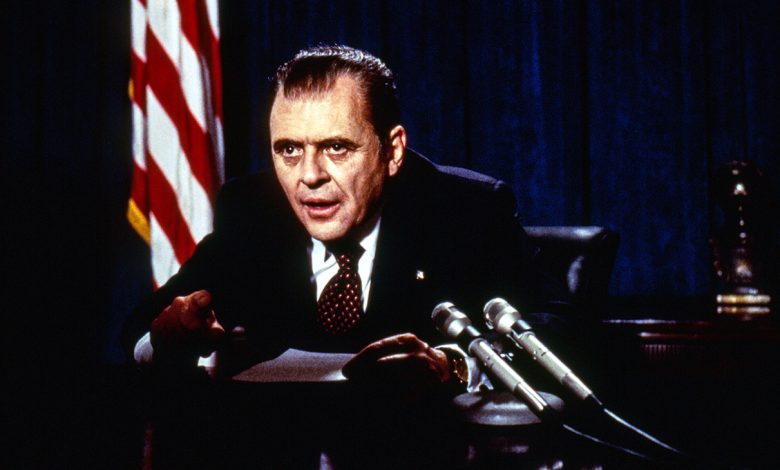
In a sweeping, picaresque odyssey that jumps back and forth in time, mixing film gauges and faux documentarian media with a riptide of quick cuts and constantly changing angles (much as he’d done in JFK), Stone channeled a mighty river of historical facts and personal drama that flows by but never drowns the viewer. He cast Anthony Hopkins in the lead role because the Welsh actor was a chameleon and played loneliness well, but also because he had an inherently sympathetic quality. When Stone offered Hopkins the part, the actor said there was no way he could play such an iconic and distinctly American figure. Stone said, “Chicken, huh?” “That’s typical Oliver,” Hopkins told me a few years ago.
Hopkins changed his mind, in part, because Stone promised not to burden him with garish prosthetics or mastering the famous voice; he didn’t want a sketch comedy imitation. Stone told him: “Nixon had the most brilliant mind, an extraordinary mind — he was just emotionally unstable, and for some reason felt a lot of shame in his life.” Stone added: “I just want us to walk in his shoes. See what it must have been like.”
The real Nixon is often lumped in with our current President, but this is historically illiterate. While there are certainly some stark echoes (hostility toward the press and all “enemies,” overreach and abuse of power), the two men could hardly be more unalike in their character. As the Trump film The Apprentice showed, this new guy simply is not very interesting or complex. He does not share Nixon’s mind, emotional depths, or better angels.
Stone does not gloss over Nixon’s manipulations and dirty tricks, the profanity and cruelty, the realpolitik and “the president can bomb anybody he likes.” In one scene, sitting at a far distance from his emotionally distanced wife, Pat (Joan Allen) — recalling the breakfast table montage with Charles Foster Kane and his wife — Nixon rings a bell to have “Mrs. Nixon” coldly removed.
But in an earlier scene, Nixon pleads with his wife not to divorce him, reminding her of their idyllic courtship days; Williams’ music here is a lyrical love theme for solo trumpet and strings — pure bittersweet Americana. As portrayed by Hopkins, this Nixon is, deep down, a broken little boy and a hopeless romantic. In another powerful scene, alone in the White House one night, Nixon looks up at a painting of John F. Kennedy and says: “When they look at you, they see what they want to be. When they look at me, they see what they are.”
The cast is packed with heavy hitters: Ed Harris as Howard Hunt; Bob Hoskins as J. Edgar Hoover; Paul Sorvino as Henry Kissinger. It’s worth watching for the performances alone.
It is also, in my opinion, Stone’s magnum opus — the apex of his angry but sorrowful interrogation of what went wrong with the country he loved so much before he was drafted into the Vietnam War, his inspiring leaders were assassinated, and his government was revealed to be corrosively corrupt. Locking arms with the likes of Hopkins and Williams, artistic geniuses who understood the assignment, Stone crafted an enormous, almost operatic tragedy that was about more than merely Richard M. Nixon, but about America itself. When we look at Nixon, we do see what we are. We are complicated, we are not Halloween caricatures, we are broken, we are marked by loss, we are horrible and we are good — and desperate to be loved.
My favorite moment in the film might be when a shattered and sleepless Nixon, with the noose of Watergate tightening around his neck, tells Pat how, when he got sick as a boy once, his mother gave him medicine that made him throw up all over her. His eyes brim with tears as Pat holds him close. “I wish I could do that now,” he sighs.
It’s an awkward thing to say, but so vulnerable — and so revealing. It’s Oliver Stone’s Nixon in a nutshell.
Join Stone and me at a 30th anniversary screening of Nixon on Sunday, December 21, at the Laemmle Royal, followed by a Q&A moderated by Stephen Farber. Details here.
HiCelebNews online magazine publishes interesting content every day in the celebrity section of the entertainment category. Follow us to read the latest news.