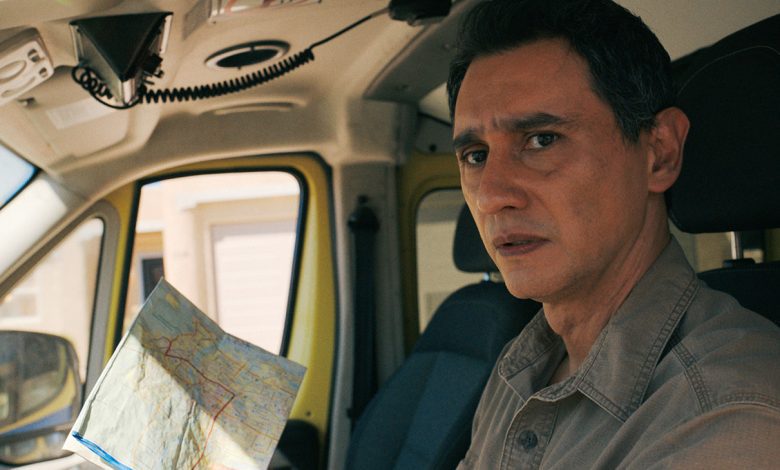
[This story contains major spoilers from Pluribus‘ season one finale, “La Chica o El Mundo.”]
Pluribus star Carlos-Manuel Vesga doesn’t hesitate to call Rhea Seehorn’s Carol Sturka a traitor.


After all, his no-nonsense character, Manousos Oviedo, risked life and limb to journey from Paraguay to Albuquerque, New Mexico, in order to meet the only person on Earth who wanted to save the world from the global hive mind that’s taken control. However, as soon as he arrives, he meets a very different Carol than the one whose VHS tape prompted him to pursue an alliance. Her urgency to save the world is no longer palpable, and she rebuffs his, in Seehorn’s words, “serial killer route” to dealing with the Joined. Two stubborn characters disagreeing over the use of violence is certainly understandable, but what Manousos goes on to discover is that Carol has fallen head over heels for her chaperone to the Joined, Zosia (Karolina Wydra).
Manousos then attempts to un-join an individual named Rick, and while the experiment fails in the moment, he comes to realize that Carol’s preferred approach of reversing the Joining in a more peaceful way is possible. He then offers to save the world with her on her terms, and she stills turns his back on him to go globe-trotting with Zosia. For Vesga, Carol became the very thing she accused the other immune “Old-Schoolers” of being in the second episode when they reacted indifferently to her pleas to save the world.
“He stays on the surface, which is, ‘You betrayed me. You sent me this video saying, “Hey, we’re on the same side. We need to change this.” I then went through what I went through, and now you’re having an affair with one of these people? You’re a traitor,’” Vesga tells The Hollywood Reporter after the season one finale.
During two weeks of isolation in Carol’s neighborhood, Manousos hit the books in order to expound on his previous findings. Out of the blue, he hears the sound of a helicopter, and it’s Carol and Zosia transporting precious cargo. Carol then exits the helicopter and finally accepts Manousos’ offer to save the world together, before revealing the contents of the newly placed container on her driveway to be an atom bomb. According to Vesga, Manousos is at a loss for words because this chess move is quite the reversal from someone who previously opposed murder.
“It was very interesting because I felt that for the first time this whole season, we see Manousos confused. He appreciates that she’s back. She seems to be on his side again,” Vesga says. “But he’s like, ‘Wait a minute, this atom bomb is too big a toy. I’m not sure what this is about.’ And that’s the point where his purpose gets all blurry.”
Below, during a conversation with THR, Vesga also discusses his theories on Manousos’ backstory, as well as how his personal interpretation of the series relates to the real world.
***
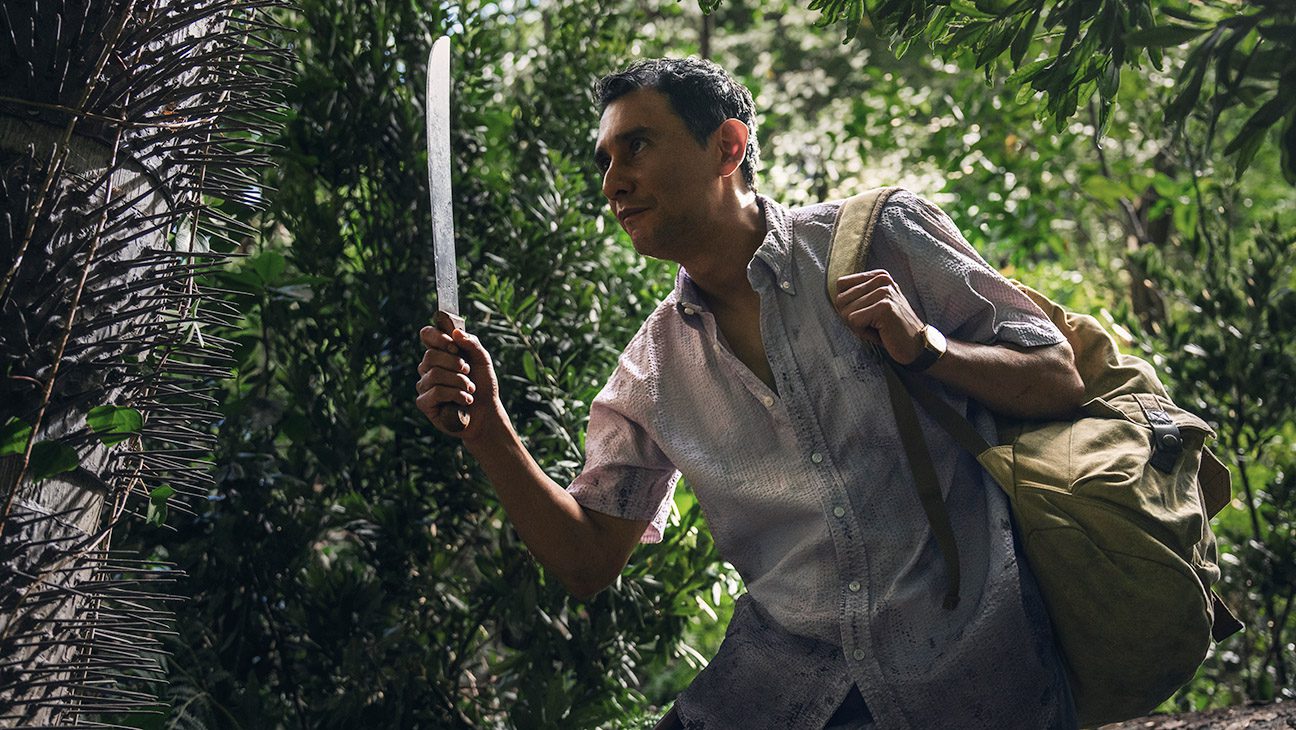
To begin with episode seven, the scene where Manousos rejects the help of the Joined and sets fire to his treasured car rather than let them put their hands on it was so incredibly rousing.
Thank you.
He has a code of honor that rivals Mike Ehrmantraut from Breaking Bad and Better Call Saul. He even leaves cash and IOUs rather than steal anything. Knowing that he’s not too fond of his mother, how do you think his background informs this conviction?
I haven’t been told what exactly happened between him and his mother, but I get the feeling that he probably wasn’t that joyful before the Joining. I don’t think that this is a guy who turned from being all smiley and happy and in love with life to this ever-frowning, very serious, sober-looking guy. I don’t think he had a lot of friends. I don’t think he was a very popular individual.
Also, he’s a migrant who migrated from Colombia to Paraguay, and now he has to migrate again. So migrating from one place to another inevitably involves loss, pain, anguish and trauma, and this guy has been through that. He has left his world behind once, and that informs a lot about how he takes the Joining. He’s saying, “Not again. Hell no. Not again.”
I’m dying to know more about that relationship with his mom because it probably [explains] his temperament. It affects you when you think that way of your mother. It has to affect you when you say, “You know what? I can tell you’re not my mother, not because you’re not sweet, but because you are.” To know she’s not his mom because she’s too sweet was such an amazing choice from the writers and the creators.
I’m sure you’ve heard the common interpretation that the show’s subtext is anti-AI. When you first read your impressively cold-blooded dialogue, “You cannot give me anything, because all that you have is stolen,” did you draw that conclusion as well?
I wouldn’t be honest if I said that AI has been in my personal equation. The genius of what Vince and his team have created is that it’s something that ignites your mind, conversation and debate without telling you what it’s about. You can read Pluribus in so many different ways. If you ask ten people what Pluribus is about, you’ll hear ten different answers.
There are things that personally keep coming to me, and I remember telling Vince that I kept thinking of Brave New World, the book by Aldous Huxley. That way of controlling people is different from 1984 where oppressed people are controlled through repression and terror. Brave New World controls people through the idea that they are happy now, so there’s nothing to fight about anymore. [“Fun fact” in Zosia voice: Season one finale co-writer Alison Tatlock was a consulting producer on a Brave New World TV series in 2020.]
I take that to our current times, and I really worry about how we are being homogenized as a mass. They have created a society in which boosts of excitement and elation only last a couple of seconds, and you need more and more and more and more. So people are controlled by feeling happy, and I kept thinking of the Joining as that society where the individual disappears. But instead of feeling fear and pain, people actually feel an idea of happiness. So that worries me a lot.
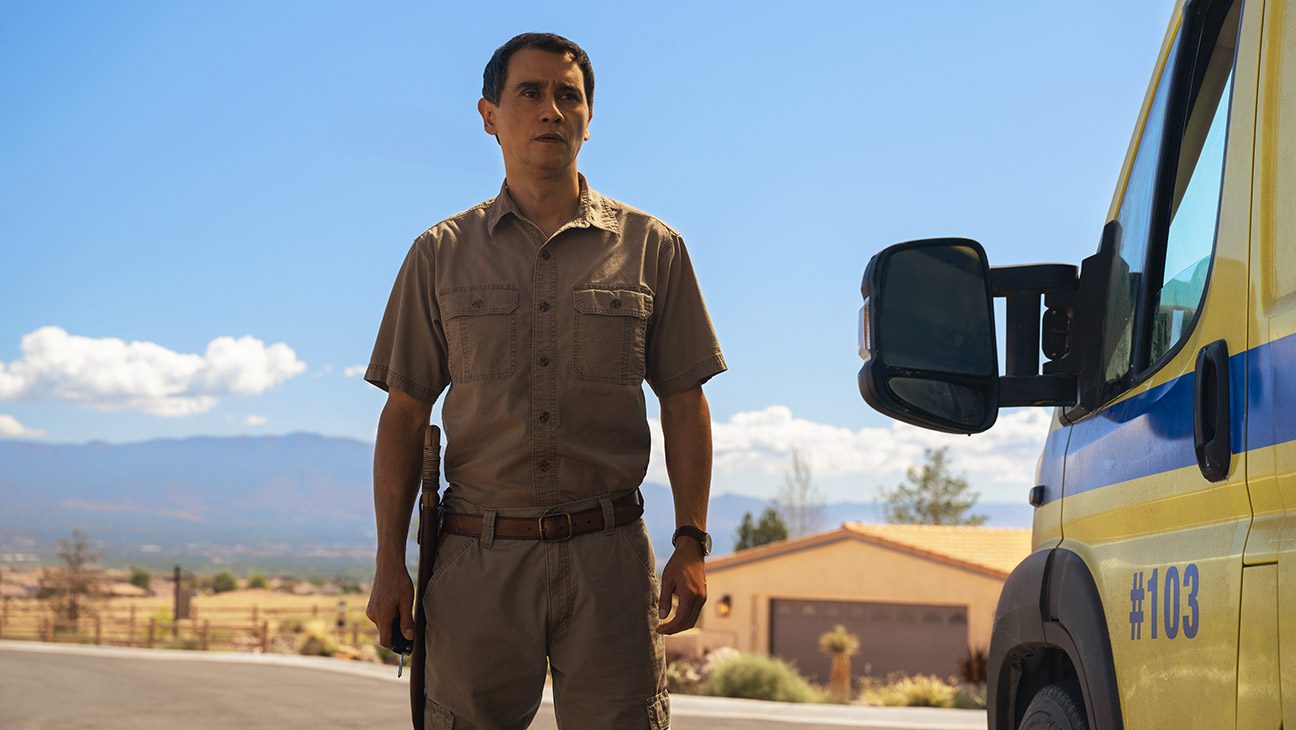
Manousos nearly dies on the long journey to see Carol Sturka, someone whom he believes also wants to save the world. But when he gets there, he comes to realize that she’s smitten one of them.
Traitor.
Does he think she’s being manipulated through her grief? The reason I ask is because there’s a shot where Manousos clocks Carol’s wife’s relatively fresh grave.
Well, I don’t know if he realizes that the loss is recent. I really think that he stays on the surface, which is, “You betrayed me. You sent me this video saying, ‘Hey, we’re on the same side. We need to change this.’ I then went through what I went through, and now you’re having an affair with one of these people? You’re a traitor. I’m not sure that you’re my friend or somebody that I can trust.” So I think he stays at that level of analysis to get to that conclusion of, “Now I don’t know if I like you.”
He conducts this signal experiment to un-join an individual known as Rick. Is that the same signal that started the Joining? [Writer’s Note: Gilligan and co. later confirmed to me that it’s not the same signal.]
I wouldn’t know if it’s the same thing. It is certainly the same signal that he notices in Paraguay when he’s registering every frequency. As I was reading the script, I asked myself the same question you asked me: “Is this connected to what those scientists picked up on in the first episode?” I love those small details that Vince and the whole creative team drop here and there. They make you think, “Oh, I understand what’s going on,” but then you realize you don’t. I love that way of taking the spectator and moving their attention to this place and going, ” Look at this. This is what’s going on. No, not really. It’s this. Now look at this.” I love that about the show.
Do you think his experiment to reverse the Joining worked? Or did Carol interrupt it before he could determine success or failure?
It seems he’s found out something. When she finally allows him to get out of the car, he says, “Look, I understand more. It was necessary what I did to that guy because now I understand so much more.” It’s a very decisive moment when he says,” Look, do you want to save the world or get the girl? Now I know more [about putting things back in their place like you wanted]. Now we can work together.” He has a very scientific mind, and he needs to test what he’s found to see what happens, so I don’t think it was a failure.
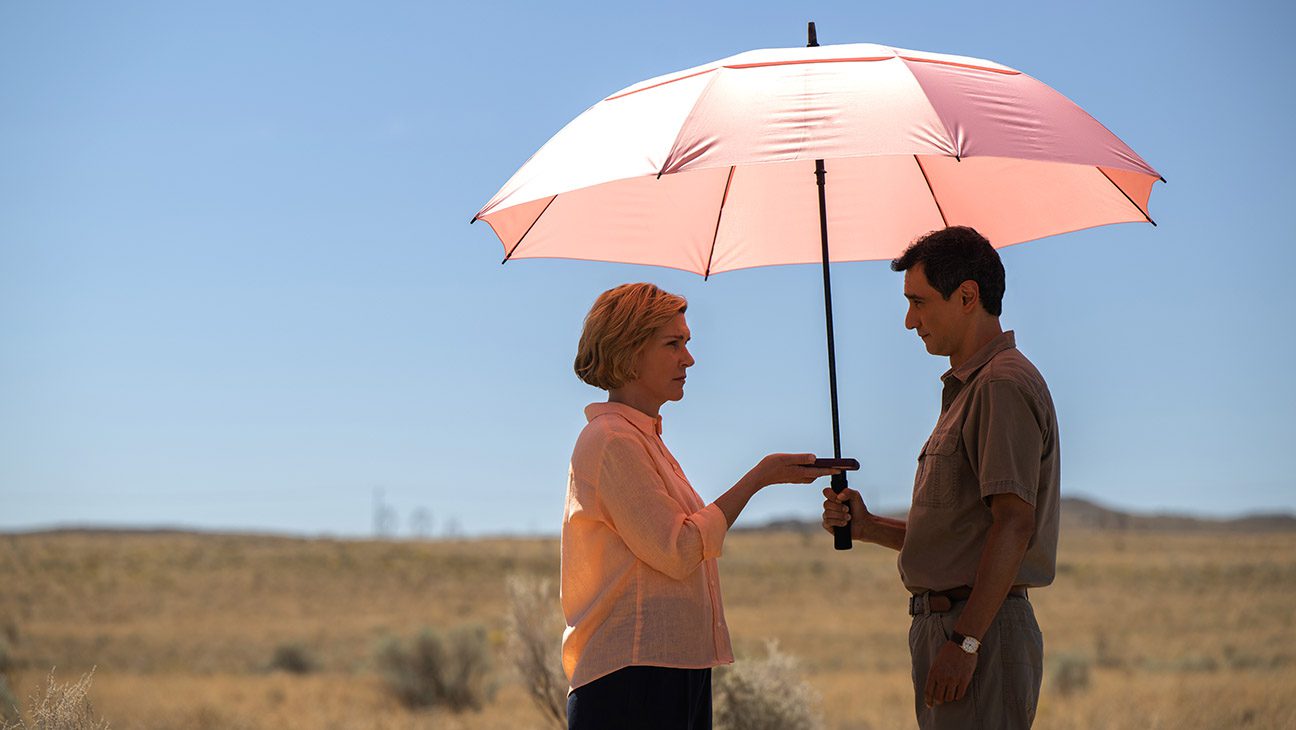
Carol returns from her romantic getaway with an atom bomb. What was Manousos’ reaction in your mind?
It was very interesting because I felt that for the first time this whole season, we see Manousos confused. We saw that drive and that strength that pulled him through the whole journey to get to Albuquerque, but suddenly, he doesn’t know what to do with this information. He appreciates that she’s back. She seems to be on his side again. But he’s like, “Wait a minute, this atom bomb is too big a toy. I’m not sure what this is about.” And I love that. The character that we’ve seen throughout the season doesn’t stop moving forward. He struggles through a journey, but he never loses purpose. And that’s the point where his purpose gets all blurry. He’s like, “I don’t know what to do with this thing,” and I love that ending for the character at the end of season one.
***
Pluribus season one is now streaming on Apple TV. Read THR’s previous interviews with creator Vince Gilligan, EP Gordon Smith and stars Rhea Seehorn, Karolina Wydra and Samba Schutte.
HiCelebNews online magazine publishes interesting content every day in the TV section of the entertainment category. Follow us to read the latest news.