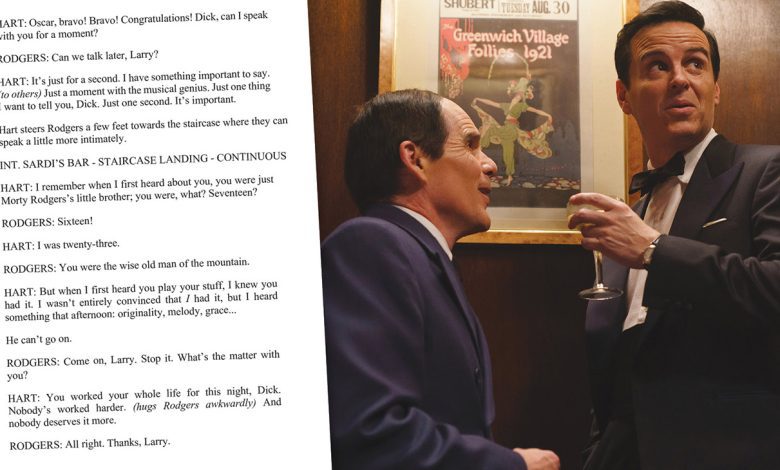
In Blue Moon, the all-in-one-night biopic directed by Richard Linklater following Ethan Hawke’s winning portrayal of the inimitable lyricist Lorenz Hart, it’s the script that sings. Writer Robert Kaplow, a former New Jersey high school teacher who previously worked with Linklater to adapt his novel Me and Orson Welles, worked on the story for this — his first screenplay — for roughly 14 years after discovering letters from a young woman to Hart at an estate sale in New York. He’s since received an Oscar nomination for original screenplay for his work of near-magical historical fiction. It’s a character study in which Kaplow imagines the opening-night party of the Richard Rodgers and Oscar Hammerstein musical Oklahoma!, the first that Rodgers (played by Andrew Scott) wrote without Hart. Through his script, Kaplow and Hawke bring to life a shrewd, longing and vulnerably discontented Hart, who during the course of roughly 90 minutes charms and transports audiences.
One of the things that drew Kaplow to this story was the complicated, yet endearing relationship between Rodgers and Hart. He set out to use this scene to truly encapsulate their bond. “The challenge of writing this staircase scene was to try to compress in a minute or two a 25-year creative partnership, a difficult creative partnership,” Kaplow says.


Sony Pictures Classics
“I think in many ways they love each other and respect each other as artists and friends. And they’re also exasperated by each other … everything is like you’re walking in an emotional minefield. And that’s the way they’ve collaborated for 25 years.”
Hawke, who disappears into the role of Hart, is also nominated for an Academy Award for best actor. There’s hardly a moment when his character isn’t speaking, and he and Kaplow together found a captivating voice for Hart.
Sony Pictures Classics
“Ethan is a writer himself, and I always saw in him an actor who feels and even tastes language,” says Kaplow. “He understood that Hart was a man who breathed language — it’s in his blood and DNA. And as Hart says near the end of the movie, ‘Larry Hart is drunk with beauty — wherever he finds it. In men, in women, in the smell of cigar stores.’ Ethan makes these lines sing because he really feels it.”
Sony Pictures Classics
“I remember saying to Richard Linklater, ‘You know, I’ve read this script a hundred times, and it still puts tears in my eyes.’ That’s the moment that just feels like it’s a love scene in a way. A love scene of people who are parting,” says Kaplow.
Sony Pictures Classics
Like with his previous collaboration with Linklater, Me and Orson Welles, Kaplow liked the idea of imagining a moment in history and the emotions that might have driven the real-life counterparts. “The facts suggest that Hart did go to the opening night of Oklahoma! Whether he showed up to the afterparty or not, that’s my invention,” Kaplow explains. “I liked it because it seemed kind of an act of bravery to show up and say to everyone there, ‘I’m still a player, I’m still involved in the world of musical theater.’ And at the same time, it seems to me a slightly self-destructive thing to do.”
Sony Pictures Classics
When it came to putting the voice and tone of Hart on the page, there was little actual text for Kaplow to pull from. Instead, he relied on the lyrics and emotions in Hart’s songs, like this bit from “Manhattan,” popularized by Ella Fitzgerald.
“I had to try to invent a voice you’d believe — that if you knew the songs, you’d say, ‘Yeah, this is the guy who could have written ‘My Funny Valentine,’ ” Kaplow says. “There was a point where I just said, ‘I have this character who just has to speak.’ I bought this school notebook and a ballpoint pen and one night I just took the brakes off and let it go. And when I was done a week later or whatever, he was speaking for 71 pages. He had that much to say. He was just burning to speak.”
Sony Pictures Classics
“It’s true what Lorenz Hart says to the people at the bar, he was offered Oklahoma! when it was a straight play called Green Grow the Lilacs,” explains Kaplow. “Rodgers went to him and said, ‘Would you be interested in adapting this?’ And he goes, ‘It’s a cowboy musical. I don’t have any interest in that.’ Well, he probably peaked in the late ’30s as a much more satirical, sardonic painter of America. He didn’t want this sentimental, waving the flag for Old Glory kind of stuff. He would never write a song like that; it just wouldn’t be who he was.”
“Part of the tension of this scene is that Rodgers is on his way up the stairs to be celebrated and Hart isn’t,” Kaplow says, hinting at the dichotomy of where the two men are at this particular moment in their lives. In fact, at the end of the scene, Hart walks back down the stairs: “Down the stairs and it’s over.”
Sony Pictures Classics
This story appeared in the Feb. 11 issue of The Hollywood Reporter magazine. Click here to subscribe.
HiCelebNews online magazine publishes interesting content every day in the movies section of the entertainment category. Follow us to read the latest news.