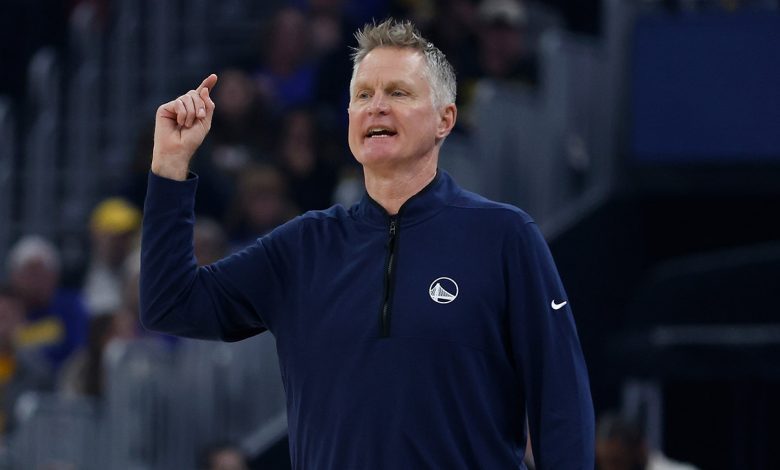
With nine total NBA Champion rings — five as a player and four (thus far) as head coach of the Golden State Warriors — Steve Kerr is a bonafide NBA legend. But what would be truly legendary is if Kerr’s bright mind could help change gun culture in America.
Kerr’s father Malcolm Kerr was assassinated by a pair of gunmen in 1984 at the American University of Beirut, where he served as president. Malcolm Kerr allowed Lebanese residents to use the college’s vacant buildings to avoid an Israeli assault on West Beirut. What he did not allow was for Israeli officers to inspect those he sheltered. Kerr’s assassination was claimed by the Islamic Jihad Organization, a militant organization close to Hezbollah.




Steve Kerr is a natural shooter — he still holds the NBA record for career 3-point shooting percentage. Given his family tragedy, Kerr has also naturally transitioned into an advocate for common sense gun safety. His two pursuits crossed paths just a few months ago when John Beam, the athletic director at Laney Community College and the head football coach on season five of Netflix docuseries Last Chance U, was shot and killed on campus some 12 miles from where the Warriors play.
At a press conference for just another NBA game in November, Kerr used his platform to honor Beam and pushed for a change in our unfortunate culture of American gun violence. Kerr’s message brought him to Joshua Seftel’s All the Empty Rooms documentary, a short film chronicling the bedrooms of children murdered by gun violence that is now on Netflix and in Oscar contention, as an executive producer. That’s where The Hollywood Reporter began its Q&A, recorded on the Friday of NBA All-Star Weekend, with Kerr.
What did you actually do here as an executive producer?
My joke, which is the dead truth, is that executive producer is a fancy way of saying, “I had nothing to do with it.” But I support it. I was asked maybe a year ago if I would be interested in being an executive producer, and immediately said, “Yes,” because I think— number one, I think it’s brilliant. I think it’s so powerful, and I think it speaks to everybody, and it cuts through all the political bullshit. And I think it’s so important. I mean, I have two granddaughters who are going to be heading off to school in the next couple of years. You know, the thought of them having to go through these active shooter drills, it’s just heartbreaking. So I just think there’s got to be ways to get through to people that this is an issue that we can tackle, and we don’t have to be pitted against each other on political lines.
What is your solution to gun violence in America?
I do work with Brady — you’ve probably heard of them. And one of the things I like about Brady is that they’re named after a Republican, and they are very much nonpartisan in their quest to protect people and save lives. But it almost sounds funny saying that, because it so clearly is a partisan issue. What Brady tries to do is cut through the political lines, and I do think that there are ways to do that. And one of the the campaigns that they have is called End Family Fire. It’s basically a nationwide campaign for gun owners to safely store their guns. So you’re really reaching out to gun owners, not far left people in San Francisco. You’re talking to directly to people who have guns. Eight kids a day are shot by un-stored guns. Seventy-five percent of school shootings happen with unsecured guns.
And so this is a really simple campaign that Brady has embarked on. This is not about the Second Amendment — it’s about gun responsibility. And in the old days, the NRA was all about gun safety. They taught gun safety. They encouraged good habits, and they were a completely different organization than they are now — now they’re just basically a wing of the gun lobby trying to increase sales. But when they first started, they were trying to teach gun owners how to be safe. And so even that alone is saving lives already.
Like most social-impact documentaries, this one was a very hard watch at times. Is there one story or scene that is particularly tough for you to watch?
Gosh, I mean, I cried several times. You know, I’ve seen it several times, and I’ve cried every time. I think the SpongeBob characters in the room (was the hardest for me). That was really, really tough … Seeing the rooms, I think, is so real because — you know, I have three kids, and they’re all grown now, but it’s like those rooms could have been my kids rooms or your kids rooms. I think that’s what hits home, is that anybody with children, it really reminds you that this is about human loss. It’s not about a statistic or political issue. And that’s the power of the movie.
You know they never mention guns one time in the film. They don’t even talk about solutions. It just focuses on the loss. And I think the most beautiful part of the film is just how deeply moved and empathetic (journalist) Steve Hartman and (photographer) Lou (Bopp) both are. Like, the juxtaposition of them going home to their own kids, and how respectful they are, you know, taking their shoes off before they go into the room. I just thought it was so beautifully done. And I don’t know that it could have happened without those two guys and their humanity and how prominent that was.
It was interesting to me that, to a family, each of the kids rooms were untouched — for some that included not picking up after and cleaning dirty laundry. No judgment on my end because far be it for anyone not in that terrible situation to say what they would or wouldn’t do, but it struck me.
Yeah, yeah. I totally agree. I thought that was really interesting, too. And it seemed to be the common thread that all the parents just wanted to preserve everything so that they could go in there and just feel the presence of their children. You’re young enough where you haven’t experienced it yet, but for every family who’s an empty nester, you go into your kid’s room after they leave for college and you sit in there sometimes and you reminisce and you think about their childhood — and they’re alive. So imagine the power of that room if the children are no longer with you. So, yeah, it was really, really something — so difficult to watch and yet so necessary to watch.
What would an Oscar mean for this film and the subject matter?
Well, I don’t really know, because it’s not my world. It’s something that I’ve thought about, and I don’t really know what to make of it. I would hope that it would just increase viewership. I think the more people who watch it, the more impact it will have. And that’s the main thing for me, is — what I want is, I want people to act, I want people to be proactive with this issue. I think Steve Hartman talks about it in the beginning of the movie, he says that human nature is to go numb and to look away — but the point of the movie is for people not to look away. It’s to address it and understand it. What my hope is, if they can address it and understand it a little bit, then they’ll be more willing to act on it.
Like a lot of issues that society has — it’s kind of a movement that has to happen. It’s not going to be, you know, all of a sudden people in Congress are going to come to their senses and say, “Oh, OK, maybe [we’ll change gun laws].” It’s going to be a movement. It’s going to be people sort of demanding it. It’s the turning of the cruise ship, is the analogy. So hopefully this will, you know, help turn the cruise ship.

7 May 1996: John Starks (left) of the New York Knicks puts a hand in the face of guard Steve Kerr of the Chicago Bulls during the Bulls 91-80 round 1 Eastern Conference Playoff win at the United Center in Chicago, Illinois.
Doug Pens/Getty Images
If you’ll indulge me, I’d love to talk some hoop here too.
Of course.
Your Warriors contract expires in a few months — what are you thinking for next season?
I love what I do. I love coaching and so this is something I want to keep doing. But you know, it has to line up organizationally, and, and I’m completely at ease with that fact. These jobs all have expiration dates on them, and you don’t know exactly when that is. But, it’s important for me that this ends in a really healthy way. So if it’s not right for next year and I move on, I’ll be very happy and grateful for the opportunity. And if it works out, great, then I’ll keep going — but we all have to be on the same page.
You were a pretty good 3-point shooter in your day and still hold the record for highest career three-point percentage. You have a guy on your team who can shoot a bit as well — is there anything you’ve personally taught Steph Curry about shooting?
I’m not touching it — I haven’t touched it. I’ve never, ever given him one bit of shooting advice.
When I was growing up, there was a commercial about the Maytag repairman. The Maytag repairman just had nothing to do all day because Maytags run perfectly. I am the Maytag repairman (with Steph).
Last week (at the time of this interview), Fox Sports talking head Nick Wright said the way to fix the NBA All-Star Game is white players vs. Black players. Thoughts?
First, I thought it was hilarious, and I’m glad we’re getting back to being allowed to tell politically incorrect jokes. But maybe he was actually serious. I don’t really know.
All the Empty Rooms is now streaming on Netflix.
HiCelebNews online magazine publishes interesting content every day in the movies section of the entertainment category. Follow us to read the latest news.