Bruce Miller has no interest in retreading old The Handmaid’s Tale ground. Over the course of six seasons, the veteran showrunner transformed Canadian author Margaret Atwood’s 1985 novel — a near-future dystopian tale about a theocratic, totalitarian regime known as the Republic of Gilead, which overthrew the U.S. government and stripped women of their rights amid a global fertility crisis — into a terrifyingly timely Emmy-winning series.
But after spending the better part of a decade charting the quiet revolution of Elisabeth Moss’ starring protagonist June Osborne — a 30-something woman gradually rebelling against her bleak life of servitude as a fertile surrogate for the ruling class after being torn apart from her husband Luke (O-T Fagbenle) and daughter Hannah — Miller knew that he needed a different entry point for his return to Gilead.




Thankfully, Atwood was already one step ahead of him, publishing The Testaments, a sequel set 15 years after the events of her most seminal novel, in 2019, which was six years before The Handmaid’s Tale would release its series finale.
Now, less than a year after that Handmaid’s Tale ending where June vowed to continue fighting underground alongside the Mayday resistance group to find Hannah and take down the patriarchal regime, the TV adaptation of The Testaments will debut April 8 on Hulu. A classic coming-of-age drama set in the oppressive pressure cooker of Gilead, the follow-up series will shift the focus from the handmaids to their successors: the young women being groomed for marriage to the ruling class of Commanders at the preparatory academy headed by Aunt Lydia, played by original series star Ann Dowd, who reprises her role among a cast of newcomers to the universe.
“This is a sequel to Handmaid’s Tale, the show,” Miller told The Hollywood Reporter during an exclusive visit to the sequel’s Toronto set last July, reiterating that his version of The Testaments is set just four years after The Handmaid’s Tale‘s ending. “There are parts of the [Testaments] book that take place very far in the future, and we want to save those things for far in the future; they’re goals we’re working towards. But there’s a compact bit of the story that takes place with the girls when they’re going through this process of finding husbands. That, as a core, is what we’re shooting for.”
While continuing to shed light on Aunt Lydia’s life before Gilead through a series of strategically placed flashbacks, the 10-episode first season largely centers around Agnes MacKenzie (played by star Chase Infiniti). “Agnes” is the Gilead name for June and Luke’s daughter, Hannah, who in this series is introduced as she comes face-to-face with Daisy (Lucy Halliday), a new arrival from Toronto with ulterior motives for joining Aunt Lydia’s academy.
After Lydia asks Agnes to show Daisy the ropes at the all-girls’ school, the teens quickly begin to feel like kindred spirits. “Just making friends is very difficult,” Miller says, “so the fact that they do quickly fall into a trust relationship and rely on each other is remarkable, and something they both feel like happens so smoothly that they’re both a little worried about it.”
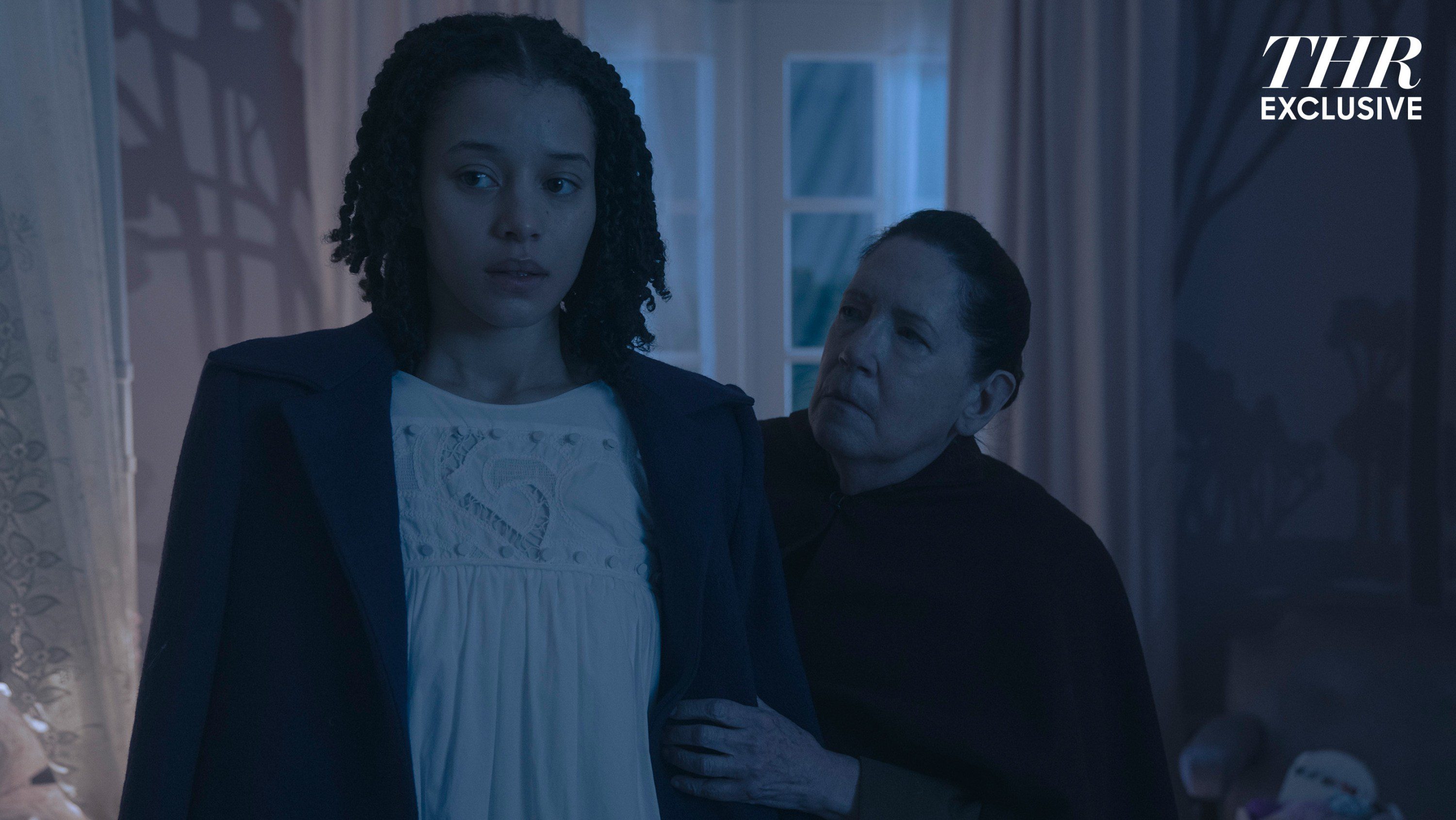
Lydia, naturally, has her own reasons for pairing Agnes and Daisy together, evolving from a ruthless zealot and disciplinarian in Handmaid’s Tale into a kind of double agent looking to overthrow Gilead from within the hallowed halls of power in Testaments, as the finale set her up to do. Dowd, for her part, says she was “thrilled” to learn, early on in the run of Handmaid’s Tale, that Atwood was penning a sequel narrated by Lydia, if only to delay having to say goodbye to her divisive character for a little while longer. In the final season of Handmaid’s Tale, Lydia grew increasingly disillusioned by the hypocrisy of the ruling elites, and she was finally forced to accept the horrific reality of her role in Gilead.
“She’s wrestling with the realization that the Commanders were not who she thought they were, and their horrid, despicable behavior. Many of those Commanders are now gone, but Commanders still are men, so ultimately they’re in charge,” Dowd told THR between camera set-ups during a busy day of shooting indoors at Lydia’s academy, where there is a striking life-sized statue of the character in the front foyer, as was shown in the trailer. “Lydia is very, very savvy, as she writes [her observations about the regime] in her room. She keeps it entirely secret, but keeps track of what goes on. So when the time comes, all the evidence is there. She’s a very smart woman who knows what she can deal with, how much she can change, [and] what the Commanders are going to be in charge of.”
As they thought about evolving Lydia in between series, the writers “were very mindful of making sure that the seeds planted [in Handmaid’s] were seeds that would bloom into this character who’s in The Testaments,” Miller says. “She’s not in a position where she has to beat people into submission. As a human being, she couldn’t do that anymore. So if she was going to take her time and change Gilead in the slow, inexorable way that she could, she has to be in a position where she can tolerate the day to day. She has put herself in a position where she doesn’t have to do the bad things anymore — but she’s absolutely at the center of influence and power.”
At the end of the day, “Lydia is more than a devotée of Gilead. She’s a devotée of Lydia, so she always thinks she’s right. It doesn’t matter if Gilead is wrong — [she thinks] she’s still right,” Miller adds. “She has the agenda of, ‘I’m going to sniff out which men are good and which men are evil, and we’re going to do a little changing of the guard.’ That’s why she took this position. As she goes along, she’s thinking, ‘Maybe these men aren’t really fit to be in charge.’ But all the way along, she thinks she’s been doing God’s work, and she still thinks she is.”
Dowd and Miller both believe that Lydia knows about Agnes’ true identity in The Testaments, but the latter points out that there’s a slight difference between knowing and being certain in Gilead. “[The Aunts] are the women who have access to the Bloodlines Library. [Lydia] knows who’s connected to who, so they don’t have any problems genetically,” Miller says of Agnes being June’s daughter. “I think she knows that Agnes is connected to June, and Lydia has been watching Agnes since she was young because she is both worried and intrigued by what June’s influence genetically will do.”
At the top of The Testaments, Agnes “is well-established, well-grounded in the world” that she has grown up in, “and she knows how to navigate everything,” Infiniti told THR, just a few months before embarking on a whirlwind global press tour and rising to fame for One Battle After Another. “I feel like The Testaments has a beautiful darkness to it because it has this very youthful, bright appearance that’s blanketed over all the cruel things that happen to these girls.” Over the course of the season, she adds, “the rose-colored glasses just come flying off,” as these young women are “thrust into their future” of servitude with little-to-no adjustment period.
Agnes begins to question the people around her, in large part due to her burgeoning friendship with Daisy. “The best way to describe [Daisy] is that she says the thoughts every viewer has subconsciously but never says aloud,” Halliday explained to THR in her natural Scottish accent. “Whenever you watch The Handmaid’s Tale, all the really logical [thoughts], like, ‘What the heck is going on? Why are these people acting that way?’ — Daisy comes in and verbalizes them. She’s the audience’s perspective in Gilead.”
In an early episode, viewers will learn through a number of flashbacks the real reason why Daisy has chosen to enter this regime on her own volition. As Halliday plainly puts it, Daisy is on a mission: “She sees Gilead as this force that has decimated her life in Toronto. Daisy doesn’t even live in Gilead, and yet Gilead has been impacting her. She’s very much set on taking down Gilead — and taking from Gilead what Gilead took from [women].”
What Daisy does not anticipate, however, is feeling a kinship with the other girls, whom she initially (and wrongly) assumed were “robots” without any crushes or dreams of their own. “The relationships are very much a wonderful byproduct of this venture into Gilead,” Halliday adds. “It’s not something Daisy’s looking for or even wants initially, but it is something that transforms her and her outlook on Gilead.”
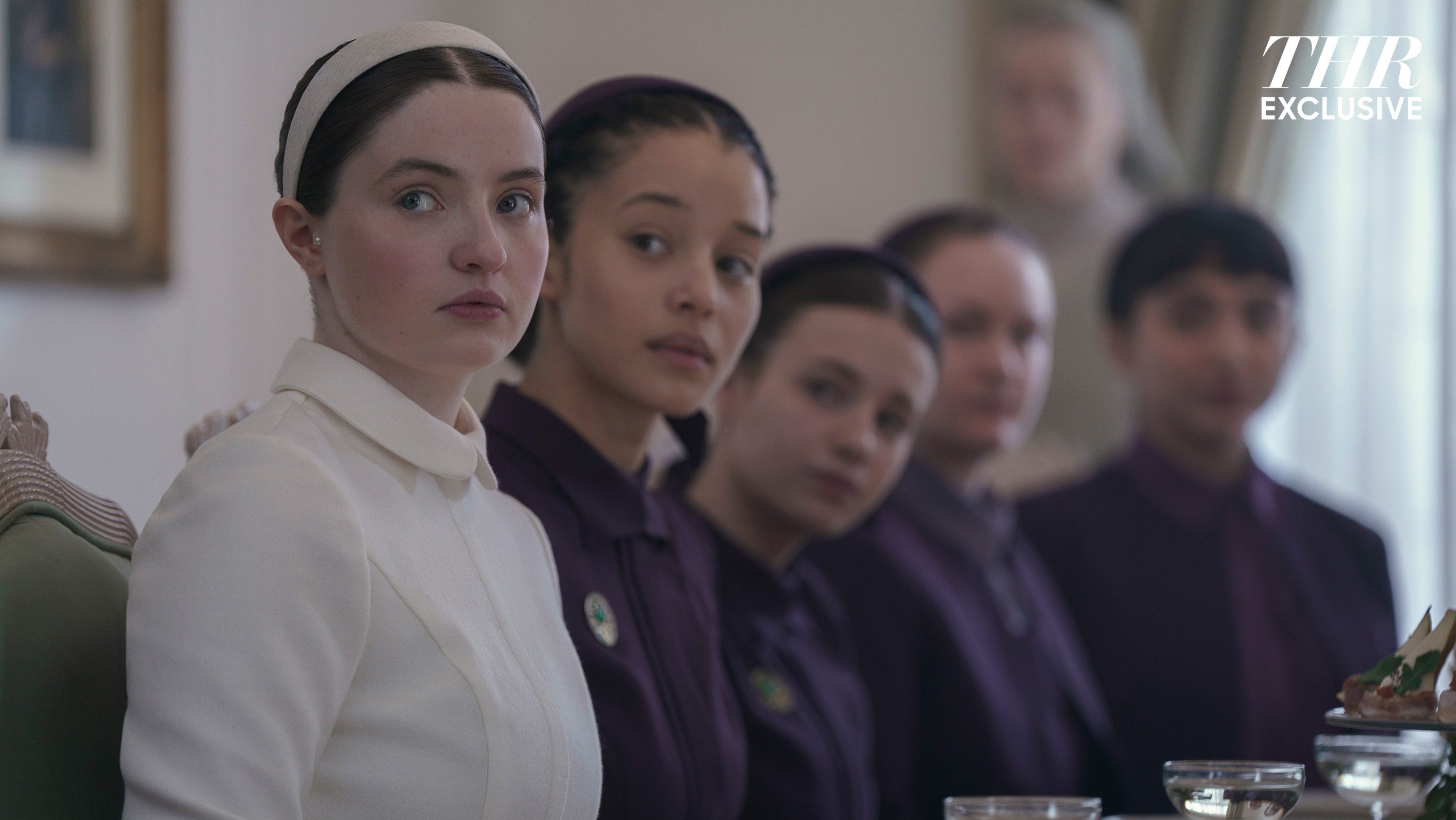
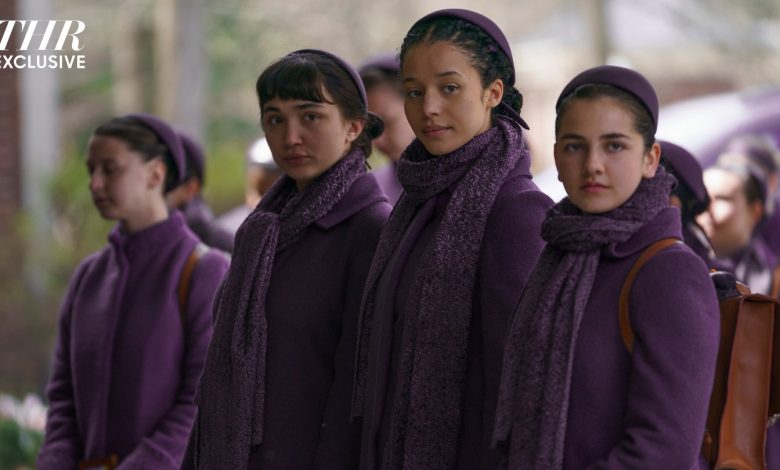
Much like in Handmaid’s Tale, famous for its striking handmaid red, color will play a central role in identifying the various social classes of women in Gilead. While Daisy stands out visually in white as a “Pearl Girl,” known as Aunts-in-training, the rest of the main girls are dressed as “Plums,” young girls who will soon be eligible for marriage.
“Gilead is choosing this color on purpose. They could choose any color they want. This isn’t by chance,” Miller says of the new plum color, which required extensive discussions with just about every head of department behind the scenes. “Firstly, it’s natural. The color itself isn’t a chemical. They’re not going to let them wear chemicals. You want it to be rich because it’s about being ripe. It’s about growing up and being full, so it has to have a thickness and not feel like rayon that feels like boiled wool.”
But in a dramatic departure from its predecessor, The Testaments feels, both in style and tone, significantly lighter and brighter, even bordering on whimsical, before the cracks begin to emerge in the girls’ lives.
“For the girls in Gilead, this is the only life they’ve ever known. This is what they’ve grown up in. So they’re not aware — or if they are aware, they’re not aware to the extent that an outsider is — of just how oppressive and sometimes diabolical the regime of Gilead actually is,” Halliday remarks. “It’s actually more unsettling for Daisy coming in to see that lightness and to really question why the girls in Gilead aren’t questioning that, and why they’re so taken in by just the normality of Gilead.
“Adolescence and teenagehood is such a strange circumstance [to begin with],” adds Rowan Blanchard, who plays fellow “plum” Shunammite. “You are dealing with some of the strongest, most visceral emotions when you’re a teenager that you’re having for the first time, and the difference between the real world and Gilead is that you have to stifle those emotions and make those emotions digestible in Gilead. You have to fit your emotions in a box and remember that your purpose ultimately is to become — and specifically at the school — a wife.”
Over the course of its run, The Handmaid’s Tale, which aired during three presidential administrations, became a culturally defining emblem of anti-Trump resistance. The Testaments will arrive amid a continued assault on the rights of women, with bodily autonomy, in particular, remaining a hot topic of conversation. In hindsight, a new expansion exploring the constraints on the next generation feels like the Handmaid’s franchise’s only logical response to the current political landscape.
After all, as Miller likes to say, “There’s nothing in the world as powerful as a 14-year-old girl.”
“You tell these girls, ‘Don’t become best friends with each other. Don’t support each other too much, because you’re here to support your husband. Now we’re going to put you all together and bind you together by punishment, and then when you get to the end, make sure you put your husband first.’ Inevitably, they put each other first; they don’t even put themselves first,” Miller says, drawing parallels with the forbidden friendships formed between the handmaids on Handmaid’s Tale. “They will do anything for the best friends they’re not supposed to have. I think they are a force that can change the world — and in this case, they do.”
***
The first three episodes of The Testaments release April 8, followed by one episode weekly. Catch up on all of THR’s in-depth coverage of The Handmaid’s Tale universe here.
HiCelebNews online magazine publishes interesting content every day in the TV section of the entertainment category. Follow us to read the latest news.