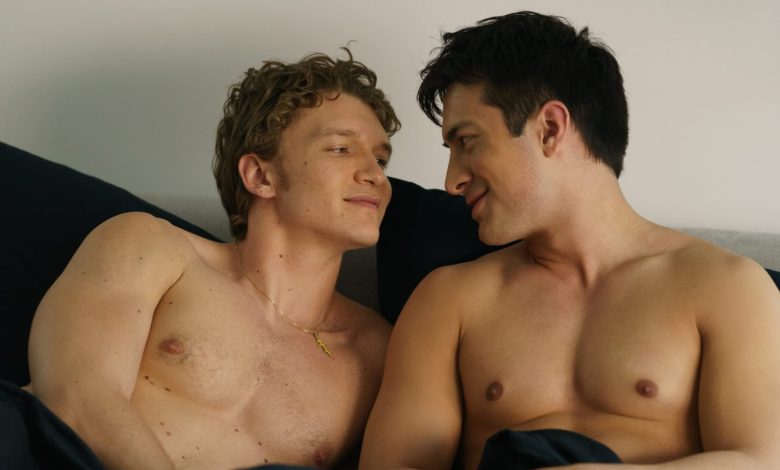
Filming an intimate scene is never as spontaneous as it looks. There’s choreography, negotiation and planning involved — especially on a show like Heated Rivalry, where sex isn’t just set decoration but one of the primary ways the story gets told.
Based on Rachel Reid’s bestselling novel and one of TV’s biggest surprise hits of the year, the steamy queer hockey drama follows the long, sometimes fraught, frequently passionate relationship between Shane Hollander (Hudson Williams) and Ilya Rozanov (Connor Storrie). “They don’t talk much. They fuck and they text, and that’s kind of what they do,” creator Jacob Tierney told The Hollywood Reporter.




Which meant that, from the outset, Heated Rivalry had to get its intimacy right — not just visually, but emotionally and ethically. The person entrusted with that responsibility was intimacy coordinator Chala Hunter, whose job was to help translate the series’ often explicit scripts into scenes that felt grounded, consensual and dramatically truthful.
“I approach every scene with the same goal of ensuring that everyone is consenting to what they’re doing and that we’re all on the same page about the action that’s going to occur,” Hunter says.
Below, Hunter discusses how working on a queer storyline shaped her approach, her collaboration with Tierney, Williams and Storrie, and how she helps actors feel comfortable on set.
What are your introductory conversations with the actors like? Especially in a show like Heated Rivalry, where sex is part of the language they’re using to tell the story.
My whole intention is to ensure that any action that’s going to take place on the day of filming has been fully consented to by all of the involved parties [and] then everyone else — this includes the crew — knows what is going to be taking place so we’re all on the same page. The consent piece is obviously essential. I literally take the material that’s in the script — anything that involves nudity, simulated sex, intimacy or hyper exposure— [and] I flag that in a breakdown. Then I bring that content to the performer and get a sense of their boundaries and consent levels.
That means having a conversation about the scripted action that allows them to feel like they’re allowed to tell the truth, that they’re allowed to say, “I’m comfortable with this, but I’m not comfortable with this.” Or, “I’m comfortable with all this scripted action as long as A, B, C, D occurs.” [The conversations] are very detailed. It requires a lot of listening on my part, not just active listening, but a kind of deep empathic listening. Sensing if someone is maybe not completely saying what they mean, and then I try to ask more questions to really flesh it out to make sure that if they’re consenting to something, they’re doing that confidently. Not because it feels coercive or because they feel pressured or because they feel like they’re supposed to say yes.
Sex and intimacy are foundational to Heated Rivalry, especially early on. How did that shape your collaboration with Jacob Tierney, and with Hudson Williams and Connor Storrie?
What it meant for me practically was knowing the scripts inside and out. I read them many, many times. I do a complete breakdown of them in this giant spreadsheet system that I have, so I felt like I had a really good internal tracking system of the narrative arc that plays out through the intimacy in this landscape.
I’m lucky to have worked with Jacob in the past. We adore each other [and] have a great collaboration. I’m always trying to respect the director’s process and space and the actors, but I felt quite comfortable being like, “Do you think that the way that this scene is playing, the way that this intimacy is playing at the moment makes sense given where we are in the story?” Or making small narrative offers. “I wonder if emotionally it should be a bit more like this. What do you think? Do you want to try one like that?” That type of thing.
When I’m on set, I’m looking at the monitors, but I’m literally listening with my whole body — sensing what’s happening for them, getting a read on whether it’s telling the story right, keeping an eye on all the technical things simultaneously. I definitely brought that to my work, my [work] with Jacob and also to my collaboration with Hudson and Connor. Luckily, we all got along really well, so that was a very pleasurable kind of back-and-forth.
In telling queer stories, are you, as the intimacy coordinator, looking out for different things than you would if it was a heterosexual couple? Are there different considerations?
Context plays such a big part in [this role]. The context within the story, but additionally, the context that the actors are living, which includes all kinds of things regarding their identities, the space that we’re in, the time of year it is, what’s happening culturally and socially at that moment. Context, context, context.
I was considering it the whole time in a holistic way, thinking about how those characters’ identities and their lived experience influences some of the [physical] actions that we’re portraying but also how it might influence their vulnerability or lack of vulnerability. But I try to not make assumptions whether I’m dealing with a heterosexual story or a queer story or a story that involves people anywhere on the gender spectrum or who have any sort of sexual orientation. I try to not make assumptions, do as much research as possible, and then genuinely look to the actor to lead it and respond in relationship to that.
There’s been comments made, I’m sure you’ve seen them, that this isn’t what gay sex looks like. How do you respond to that?
Everyone has their own experience of what is and isn’t authentic. It’s not for me to tell anyone what is or isn’t authentic for them. Everyone has their own subjective experience of being in the world and certainly of what feels authentic to them. Intimacy is even more heightened, [and] it’s a very individual, specific experience.
These scenes put actors in vulnerable positions. How are you making them feel more comfortable?
I try to bring a very grounded, direct, calm energy to set. I set that tone early on in the conversations with the actors where ideally I’m trying to establish trust with them, let them know that I’m their advocate, that I’m there to support them and ensure that anything that’s occurring in the filming of this intimate content they’ve consented to.
I feel like my approach is [coming from a] direct, grounded [and] real place. I have felt that takes the curse off of it. [I’m] just naming things for what they are and allowing people the space to feel uncomfortable, to feel shy, to ask questions, to actually feel empowered to just ask for what they need or vocalize what’s going on for them. I find if I come at it with openness, relaxation and directness, that really [helps] actors to feel agency and a level of comfort. Even if they are feeling a bit awkward or nervous. It’s a vulnerable thing to do.
Connor and Hudson have to build their own repertoire with one another as characters and actors. As we’ve discussed, the intimate scenes play a big part in the story. How are you helping in build that relationship to feel comfortable in that sense.
Connor and Hudson are both so talented and so wonderful as people that they really built a lot of that themselves with Jacob. When it came to intimate moments, we would all kind of catch up with each other. I felt it happened very organically in this case, honestly, that it was like it’s kind of the dream artistic collaboration.
HiCelebNews online magazine publishes interesting content every day in the TV section of the entertainment category. Follow us to read the latest news.