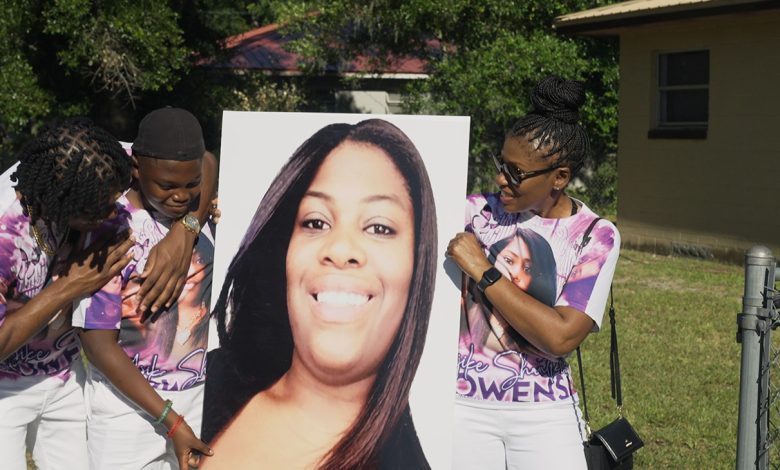
On June 2, 2023, Ajike Owens, a 35-year-old Black mother of four, was fatally shot by her 58-year-old white neighbor, Susan Lorincz. The deadly altercation marked the end of a two-year saga of responses from Marion County police to calls from Lorincz about noise coming from the children in their Ocala, Florida, neighborhood and false complaints of trespassing.
Fearing Florida’s Stand Your Ground law would absolve Lorincz of any criminal wrongdoing, filmmaker Geeta Gandbhir and her partner, producer Nikon Kwantu, who were family friends of Owens, immediately went into action to keep the slain mother’s story in the news. When they received a thumb drive with body cam, dash cam and other footage detailing the events leading up to Owens’ death, they realized there was much more to say about privilege, policing and the impact they have on communities of color.

Gandbhir and producer Alisa Payne spoke with THR at SCAD Film Festival about the resulting documentary, The Perfect Neighbor, which instantly gained traction on Netflix, reaching 16.7 million views within the first three days of its Oct. 17 release.
Geeta, this documentary begins with you and your personal connection to Ajike. How did you move from grief to seeking more answers to, “I think we have a documentary here”?
GEETA GANDBHIR The night that Ajike was shot, we immediately sprang into action along with the community and her network to try to keep the story alive in the media. As you saw in the film, Susan Lorincz was not immediately arrested, and we weren’t sure because of Stand Your Ground if she would ever be arrested. Two months after the incident, we received from the family lawyers the body camera footage. They used the Freedom of Information Act to request from the Marion County Sheriff’s Department all the materials related to the case. That included body camera footage, Ring camera footage, dash cam video, detective interviews and the 911 calls that you hear. I took a couple of weeks, because I used to be an editor, and strung it out. That was sort of our process of grief work. But also, we felt really compelled to understand how this could happen. How is it that someone picks up a gun to solve a trivial dispute with their neighbor over children playing in a yard next to their house, where they had permission to be? And after I strung it out, we realized that the police had been called to the scene for two years. And that’s when we thought there might be more [footage] that we possibly could make a film [from].
So much of the impact of the film comes from the fact that it is just footage — no reenactments, no confessionals. What led to that creative decision?
GANDBHIR The decision to live in the body camera footage came from a couple places. One, when I thought about going back to and re-interviewing the community and asking them about what had happened, I didn’t want to re-traumatize them through that process. What you hear in the film are the detective interviews. So they’d already had to relive it, and I couldn’t see doing it again. Then there was the piece of how immersive and undeniable the body camera footage is. We were not on the ground as filmmakers directing anything. This footage shows things exactly as they unfolded — without a reporter, without a filmmaker, without a journalist on the ground. So it feels undeniable. It also feels immersive and cinematic to us as filmmakers. The cops functioned, unintentionally, as multicam. Something that we found so extraordinary was they unintentionally captured this beautiful community as they were before. And you never get to see that. You never see a community, particularly one like this, living their lives with this strong social network, raising children together kind of, all the love you see. And we really wanted to subvert the traditional use of body camera footage — which is used for people of color to surveil us, to criminalize us, to protect the police — by showing these children as they were and humanizing them.

Susan Lorincz is interrogated on camera.
Courtesy of Netflix
The scene when Susan is given the option to write a letter to Ajike’s family is so arresting, not only because of the anticipation of what she’ll say but also the decision not to speed up the time and make audiences sit with that suspense.
GANDBHIR I am obsessed with that scene. I’m obsessed with that final moment where the police cannot get her out of the chair. It’s so fascinating to me to hear reactions to it. Sometimes people laugh, they’re furious, they can’t believe it. But for us, it really showcased who she was. She is a person who repeatedly tried to weaponize her privilege and her police against this multiracial community. But her anger was really directed toward Ajike and her children, who are Black, and she was using it to manipulate the police. [The scene] is the epitome of their relationship throughout the film where [the police] treat [Susan] as a client and they ultimately do not see the community as being worth protecting. When the detective comes back and he’s reading [what she wrote] for the camera, to me that was so powerful. We got to hear it. The idea of show-and-not-tell is critical in this type of storytelling. We believe our audience is smart and engaged and can follow the story without the extra hand-holding and can come to their own conclusions.
How did Ajike’s mother, Pamela Dias, react to the film, and how are she and Ajike’s children doing?
ALISA PAYNE Anyone who’s lost a parent so young, the main provider, the main hugger, kisser, there is a definite gap in their life. Pam was living in another state and had to leave her job, her friends and her existence as she knew it to go and raise these kids. But nothing can replace a mother’s love. So she says that they are courageous and brave because they go out into the world every day despite all the fears that they have. They’ll never be the same, and the children and the adults in the community will never be the same. But in her turning pain into purpose, [Pam] has started Standing in the Gap Fund to support other families who have experienced race-based violence. We encourage everyone to go to standinginthegapfund.org to see what they’re doing.
GANDBHIR Before we sent [the doc] to the Sundance Film Festival, which was our [distribution] route as an independent film, I shared it with her and I said, “Here’s the film. We can send this to Sundance and see what happens. It may go nowhere. It could end up on YouTube; we don’t know. This is your choice, this is your daughter’s legacy.” So she watched the film the first time, and it was very hard for her. Obviously, she was surprised by the footage. She was shocked, she was grieving. And then she said she prayed on it, and she watched it again, and she was able to see it as a piece of art that could speak to her daughter’s legacy. She tells a story about how Ajike was this very bright young woman who had so many big dreams. She was an amazing mother, but she also wanted better for herself in the world. One of the last things she said to her is, “Mom, you laugh at me, but wait, one day the whole world is going to know my name.” So this is what we were left with; this is what Pam is left with. And I think in Ajike’s absence, she wants the whole world to know her name and to remember her, and hopefully we can make change in her name. This is the goal.
HiCelebNews online magazine publishes interesting content every day in the movies section of the entertainment category. Follow us to read the latest news.