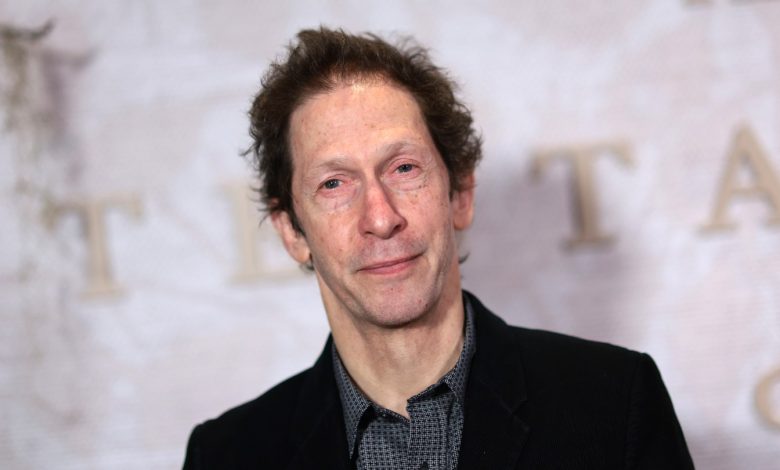
Tim Blake Nelson was at work on a complex, sophisticated novel about the making of a Hollywood superhero film when he got the offer to star in one. The consummate character actor, known for everything from his decades of Coen Brothers collaborations to his lauded turn in HBO’s Watchmen, reprised his role of biologist Samuel Sterns from 2008’s The Incredible Hulk on Captain America: Brave New World. He had also appeared in an iteration of Fantastic Four in between, so he already knew the landscape well enough. But suddenly, he had the opportunity for some immersive field research.
This is not Nelson’s first novel — his first, City of Blows, published a few years ago — and he’s eager to prove himself as more than an actor trying his hand at a new medium. He shouldn’t have to try too hard, since he’s been writing plays and directing movies for decades. But this one matters to him. A classics graduate out of Brown University, Nelson writes with surprising literary rigor, less interested in the frothy behind-the-scenes drama you might expect someone of his experience to focus on, and more in the larger questions posed by the cultural dominance of Hollywood’s superhero franchises. His dialogue is ambitious, edging toward the philosophical.
Now available for purchase, Superhero interrogates the making of a fictional Marvel-esque tentpole, featuring a washed-up movie star in his comeback role, a hotshot young director questioning his shift into the corporate big-leagues and an occasionally insubordinate cinematographer. There are on-set tantrums and discussions around how the movie can be streamlined with AI. In other words: If you follow Hollywood, you’ll notice many instances of Nelson drawing from real life. He doesn’t hide this at all, but hopes Superhero isn’t taken purely on those terms. After all, as our wide-ranging conversation reveals — also covering Nelson’s small but memorable role in The Testament of Ann Lee (now in theaters) and his next directorial effort — this is a guy who cares about the art. In the process, his book contains fresh, nuanced wisdom about the genre that’s come to increasingly define his industry.

The Unnamed Press
When you publish a book like this, what’s it like to get feedback from friends in the industry?
Very few have read it at this point. Ari Aster and Amanda Seyfried read it, they blurbed it. And then my friend [producer] Debbie Liebling. Those would be the main three. And then [my publicist] Mara Buxbaum read it because I based a character on her and I wanted to get her perspective on the publicity section of the novel and make sure I’d gotten that right. Other than that group, I really don’t have much feedback. It’s very important for me in this novel to be accurate about the world I’ve experienced as an actor and filmmaker. It is easy to construe this novel as satire and insofar as there’s a degree of concentration and elimination of unnecessary detail, it is heightened reality. But that’s as far as it goes. Everything in this book I’ve either experienced or heard about from somebody who experienced it directly. So I don’t look at this as a wildly exaggerated world that I’m depicting.
The book examines modern American culture through the lens of the superhero film and its sheer popularity. You focus on the making of one fictional movie in particular. On a macro level, what was the idea there?
When something is as pervasive and powerful and such a driver of choices in an industry writ large, you have to ask how and why. Your answers are inevitably going to address broader issues culturally. So specifically, why did superhero comics originate in America? Why did superhero movies also originate in America based on those comics at the moment they did at the turn of our present century? This is the microcosm of the making of a tentpole movie as a way of looking more broadly at our culture where it is right now.
So who are you, Tim Blake Nelson, in that equation? I think of your career, decades spent on these kinds of sets, mostly in supporting parts — have you always felt like a kind of fly on the wall, taking in these dynamics and trends as you’ve navigated the industry?
I have two answers to that. One is more ad hoc and immediate — I had already started writing Superhero when I was offered to return to the MCU to play the leader in Captain America [Brave New World] As a result of that, on that set, I had many conversations with people in the know like Nate Moore and Kyana F. Davidson, but also the guys who ran the scanning trailer and the DP, other actors, as a way of fortifying the accuracy of what I was up to.
Otherwise, I never have walked on a set thinking, “I want to write about all this, so I better observe it.” I’ve just reveled in the experience of getting to make movies for 30 years. It has been incredibly meaningful to me. I can’t think of a better life than the one that I’ve gotten to live doing that. In many respects, I approach this as an enthusiast and I would like to think of Superhero as more of a love letter to movie making than any sort of a screed against it. Even though a lot of what happens in the book borders on the ridiculous because of the behavior of narcissistic selfish venal individuals.
Peter, the lead of the movie and also your protagonist, can be a little tough to take at times. I’m sure you’ve been around all kinds of number-ones on the call sheet.
He’s based on about four different actors. He’s not meant to be any of them specifically. What I really wanted to do with that character was to create a current American tragic hero. He is informed by my reading of American literature and my love of that sort of figure. He is the type of character that goes all the way back to protagonists in Greek theater. He’s hubristic, he’s charming, he would seem to have it all, but for this one blindness in extreme that is going to bring him down in a way that you could never have expected, but in retrospect feels like it was inevitable.
To be clear, the novel is careful not to be some sort of a takedown or gotcha novel. And so I’m really not interested in people saying, “Oh, this character is that real person.” It’s not Primary Colors because I don’t think that stuff is as interesting as the other ambitions of the novel. I would look at that as a distraction. Even though I’ve based it on a lot of real people, I deliberately went back and made it not about any specific real person because I don’t want that. That said, the DP is based on Guillermo Navarro, and he knows that, which is funny.
Do you worry people will read it that way, though? Less as literary fiction and more as thinly veiled tell-all?
Yeah. And I also know and need to overcome this, but I know that many people are going to look at me and say, “Why doesn’t he stay in his lane and just be an actor? Why do these people think they can just go out and write a novel?” The ambition here is to write a real novel. It’s not a vanity thing, and I didn’t take it lightly — I don’t take writing novels lightly, which is why I waited until my 50s to write my first one.
In terms of where superhero movies are at this exact moment, much has been made of their relative box-office downturn over the last few years. What do you make of that, as both a participant and someone obviously very engaged in their cultural import?
Superhero movies certainly aren’t what they were at their apogee, but they remain powerful, pervasive, and meaningful. They still make money as well. That to me is a little less meaningful than a lot of other really big stuff, although it dovetails — because from when Iron Man was made all the way through to the end of the Avengers trilogy, box office was what it was all about. When a movie like Deliver Me From Nowhere, which I thought was a wonderful movie, doesn’t do well at the box office, there’s a lot of hand wringing. But more and more with superhero movies as well as Deliver Me From Nowhere, they’re really counting on downstream revenue — streaming and VOD. That to me is where the disruption is really taking place. And it’s bad.
Disruption is usually bad and painful for a lot of people who work inside of an industry. So it is a tough, tough time right now, and it’s especially tough for those of us making indie films. It’s really hard for us to raise money because it’s really hard for companies to believe that the negative costs are going to be eclipsed once a movie is finished. And a company like Searchlight or A24 or Bleecker Street or Magnolia is going to need to see profit after a meaningful purchase price. It’s a fucking cascade throughout the industry because fewer films are being made. The ones that are being made are made for far, far tighter budgets.
That means every craft is being paid less money. That means the actors are being paid less. That means the directors and writers are working for scale and subsidizing the making of their own projects. It means when you roll into a town, you’re needing more and more soft money from states. When you’re hiring from the local unions, you’re constantly in a fight with them about how many people you’re going to be required to hire for them not to go on strike. So then movies go overseas to shoot where they can escape all that. It’s so impactful in every respect, you just wonder how we’re going to make it through. We will, because I don’t think that interest in movies is going to wane, but there’s a lot that we’ve lost from the ‘90s and early 2000s that I’m not sure will ever regain.
You have a small, wonderful part in The Testament of Ann Lee. Did you glean anything from the way that Mona Fastvold and Brady Corbet make their movies, just in the scale versus the budget and how to accomplish that?
Brady and Mona make movies for movie theaters that are experiences, and they’re an example of why AI will never replace human creativity, because AI could never come up with The Brutalist or The Testament of Ann Lee or Childhood of a Leader or Vox Lux or The World to Come. There. I just basically named their whole filmography. But yeah, Brady and Mona mean business. They make these movies on the vanguard of filmmaking right now, and that’s why you want to be around them. It’s why I went to Budapest to play a cameo in their movie, to experience the making of great storytelling that should only be experienced in a movie theater.
Brady and Mona, like Joel and Ethan [Coen], like Ari Aster, Aaron Schimberg, these are the people. They’re the reason I get up in the morning to do what I do. They inspire me and they fortify my belief in the enterprise of making movies.
You just directed another film, The Life and Deaths of Wilson Shedd. Amanda Seyfried is in it. She also blurbed your book, as you mentioned. Is it safe to say you’ve developed a bond?
Amanda and I have become extremely close, very quickly. I’ve gotten to know her family really well. I love her husband, Tommy [Sadoski], and they have two fantastic kids. Amanda is everything right about maintaining artistic integrity and personal integrity. She’s one of the best people I’ve ever met doing what I do. She’s a wonderful actress, an incredible person, and a beautiful mom and a true friend. And what’s remarkable about Amanda is she’s so approachable and so decent and so true to who she is. So unafflicted by ego. We got along really well on Ann Lee, and I’d known I wanted to offer her the lead in Wilson Shedd throughout the process. I knew that I was going to have to talk to her about it. I just said, “I have a script I’d love for you to read and consider acting in.” She asked me for a copy and I handed it to her. Within two days she was in, there was no attenuation of the process. No gamesmanship. No mention of the fact that she had a dozen other scripts she was looking at. No haughtiness. Just an approachable person without any pretension or condescension — just a true person.
Where are you in terms of the edit and, given what you’d said earlier about the state of selling these kinds of movies, what are your hopes in the months ahead?
We are finishing visual effects and about to color-time. The movie is locked and mixed, and I’m incredibly excited about it. I’ve been able to share it with my cohort, and a lot of the people I’ve just mentioned have been really helpful in helping me shape it, and I’m excited to bring it to a festival somewhere next year. We’ll just have to see where that is. It’s just not done yet. I should be done with it by the end of January.
I tried to get this movie made for 10 years. The first draft is over 10 years old, written in 2013, and it’s been through all sorts of financing iterations. Cast members have come in and out of it. When I finished shooting, I became convinced that it took 10 years because without even realizing it, I was waiting around for Amanda and Scoot [McNairy]. They’re that good in this movie — it’s unbelievable what they do. But yeah, it’s a little bit out of my hands because a festival has to take it, and then somebody has to buy it. I hope you’ll see it next year.
HiCelebNews online magazine publishes interesting content every day in the movies section of the entertainment category. Follow us to read the latest news.